
Let's get one thing straight: effective time management for real estate agents isn't about perfectly color-coded calendars or finding the "best" to-do list app. It’s about building a system—a personal operating system, really—that ruthlessly protects your time for the things that actually make you money.
The top producers I know have mastered this. They’re fiercely protective of their time for building relationships and closing deals, while finding clever ways to automate or delegate everything else.
Why Traditional Time Management Fails in Real Estate
If you’ve ever tried to follow standard time management advice, you know it feels like it was designed for a 9-to-5 desk job. That beautiful schedule you planned on Sunday evening? It’s usually blown up by 10 AM Monday after a frantic client call, a last-minute showing request, or a fire you have to put out on a pending sale.
Sound familiar?
The unpredictable, always-on nature of real estate means generic systems just don't cut it. You're constantly reacting, putting you in a state of being busy but not truly productive. It’s a fast track to burnout and a plateaued income.
Shifting from Managing Time to Prioritizing Impact
Here’s the fundamental problem: most time management advice is obsessed with efficiency—doing more things faster. But for a real estate agent, the real goal isn't just efficiency, it's effectiveness. It’s about making sure your hours are spent on high-impact activities that generate real results.
This means you have to shift your mindset from just managing a calendar to ruthlessly prioritizing what matters. Before you dive into any task, you have to ask yourself:
- Will this get me into a conversation with a potential client?
- Will this move a current deal closer to the finish line?
- Is this truly the best use of my time right now to grow my business?
Making this shift is what separates the top earners from everyone else. The numbers don't lie: in the competitive world of real estate, the top 20% of agents handle 65% of all transactions. These agents average a staggering 26 deals per year, while the bottom 80% struggle to close just 3.5. You can see more data on this performance gap over at mikedp.com.
That difference isn't about luck—it's about a superior system for managing time and energy. This guide is your roadmap to building that system.
To get a head start, you can also learn about the best practices for digital asset management to get your marketing collateral in order before you even begin.
To frame our approach, let's break down the core components of what truly moves the needle for a successful agent.
The Three Pillars of Agent Productivity
| Pillar | Core Principle | Key Outcome |
|---|---|---|
| Prioritization | Focus 80% of your time on the 20% of activities that generate revenue. | More qualified leads and faster closings. |
| Systemization | Create repeatable routines and workflows for common tasks. | Reduced stress and consistent, predictable business growth. |
| Optimization | Continuously refine your systems using delegation and technology. | More free time and a scalable business that runs without you. |
By mastering these three areas, you move from a reactive agent constantly putting out fires to a proactive business owner in control of your growth and your schedule.
Designing a Schedule That Actually Works
Let's be honest, most real estate agents don't run their day—the day runs them. To take back control, you have to stop living off a reactive to-do list and start building a proactive schedule. A structured day isn't something that just happens; you have to design it with purpose. This is the bedrock of time management for any agent looking to grow their business without completely burning out.
It all starts with owning your morning. Before you even think about opening your email and letting other people’s emergencies hijack your day, you need to lock in your "Daily Big 3." These are the three most important things you can do today to actually move the needle on your income.
Here’s what that might look like:
- Follow up with every single lead from yesterday's open house.
- Call 10 past clients just to check in and strengthen that relationship.
- Draft and schedule the social media campaign for this week's new listing.
Knock these three out first, and you’ve already won the day. No matter what chaos ensues later, you’ve accomplished what truly matters.
Time Blocking Your Money-Making Activities
Once you know what your priorities are, you have to guard them fiercely. That's where time blocking becomes your best friend. It’s a simple concept: you're not just making a list of things to do, you're making appointments with yourself to get them done.
Think about it. Prospecting, lead follow-up, and nurturing your sphere of influence are the lifeblood of this business. They deserve a permanent, non-negotiable spot on your calendar. When you block out a solid 90 minutes every single morning for lead generation, you’re treating it with the same respect as a listing presentation. It’s a lot harder to skip when you see it as an appointment you can't break.
The point isn't to create a schedule so rigid it shatters at the first sign of trouble. The goal is to build a reliable framework that guides your decisions and protects your most valuable asset—your time.
This whole process is about creating a workflow that supports your productivity, not just adds more tasks to your plate.
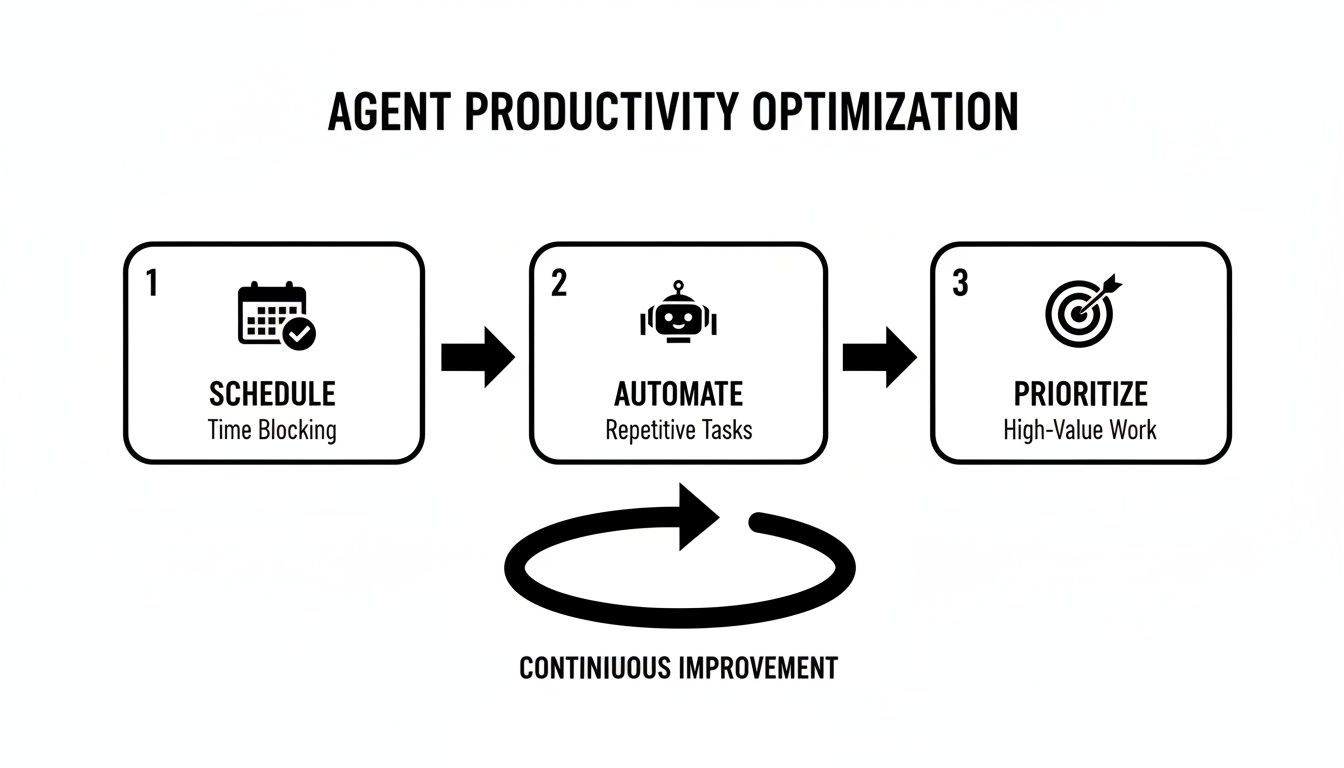
As you can see, a solid schedule is just the starting point. It gets even better when you add smart automation and a clear sense of your priorities into the mix.
The Weekly CEO Hour
To make sure all this daily hustle is actually taking you where you want to go, you have to step back and work on your business, not just in it. I call this the "CEO Hour." It's a sacred, 60-minute block of time you schedule every week—maybe Friday afternoon to wrap up or first thing Monday to kick things off.
During this time, you put on your CEO hat and focus on the big picture.
- Review Your Pipeline: Where does every deal stand? What needs to happen next for each active client and lead?
- Analyze Your Numbers: Are you on track to hit your GCI goals for the month? How many appointments did you set this week? Know your data.
- Plan the Week Ahead: What are next week's "Big 3"? Get those key appointments and time blocks on the calendar now before the week even starts.
This weekly ritual is your steering wheel. It’s what keeps you from drifting aimlessly from one urgent task to the next. It’s your dedicated time to think like a business owner, solve problems before they blow up, and set yourself up for another winning week. This is how you build a schedule that finally serves you, not the other way around.
How to Prioritize What Actually Matters

Having a schedule is a great start, but it doesn't tell you what to do. The real secret to effective time management in this business is knowing how to prioritize for maximum impact. A long, rambling to-do list where every item feels like a top priority is a fast track to burnout and mediocre results.
The trick is to stop thinking like a checklist-maker and start thinking like a CEO. That means getting good at telling the difference between tasks that just keep you busy and the ones that actually grow your bottom line.
Sort Your Day with the Eisenhower Matrix
One of the best tools I've ever used for this is the Eisenhower Matrix. It’s a simple but powerful grid that forces you to categorize everything on your plate based on two things: urgency and importance.
- Urgent & Important (Do First): These are the fires that need putting out right now. Think contract deadlines, critical client negotiations, or an offer that just came in.
- Not Urgent & Important (Schedule): This is where top producers spend their time. We're talking lead generation, nurturing your network, and building your brand. These are the things that build a long-term business.
- Urgent & Not Important (Delegate): These are the interruptions that feel important but really aren't. A non-client wanting a quick CMA or scheduling a showing for a tire-kicker can often be delegated to an assistant or buyer's agent.
- Not Urgent & Not Important (Delete): Be honest with yourself. This is the endless social media scrolling, organizing your desk for the tenth time, or getting lost in Zillow. Cut it out.
For example, an email from a lender might feel urgent, but is it really more important than calling five past clients for referrals? The matrix gives you a quick, gut-check way to make that call.
Your goal is to live in the "Important but Not Urgent" quadrant. This is where you work on your business, not just in it. This is proactive growth, not reactive firefighting.
Find Your Money-Makers with the 80/20 Rule
Another game-changing concept is the Pareto Principle, better known as the 80/20 rule. For us in real estate, it basically says that 80% of your commission will come from just 20% of your activities. Your job is to figure out what that vital 20% is and ruthlessly protect the time you spend on it.
So, what does that magical 20% usually look like?
- Lead follow-up calls
- Listing presentations
- Negotiating contracts
- Deepening relationships with your best referral sources
On the flip side, you’re probably spending 80% of your time on stuff that only brings in 20% of your income, like paperwork, low-priority emails, and other admin tasks that keep you busy but not productive.
Group Similar Tasks with Batching
Okay, so you've figured out your priorities. Now, how do you get it all done efficiently? The answer is task batching. This just means grouping similar tasks together and knocking them out in one focused block of time.
Instead of bouncing from your inbox to your CRM to a phone call and back again, you create dedicated work sessions.
- Admin Block (1 hour): Get it all done at once. Update your CRM, process paperwork, and clear out non-urgent emails. Then, close those tabs and move on.
- Marketing Block (90 minutes): Write all your social media posts for the week, draft your newsletter, and use a tool like AgentPulse to quickly create videos for all your listings. Don't let it bleed into the rest of your day.
- Prospecting Block (2 hours): This is sacred. No interruptions. Just you, your phone, and your list. Make your follow-up calls, send personalized texts, and connect with your sphere.
This approach saves an incredible amount of mental energy. You avoid the constant "gear-shifting" that kills focus, allowing you to get into a state of flow and produce higher-quality work in a fraction of the time.
Let Automation Work for You

Once you've figured out what tasks truly move the needle, the next move is getting everything else off your plate. The good news? You don't need a huge team. Smart automation is your secret weapon, handling the repetitive, time-sucking work so you can focus on the human connections that actually close deals.
Marketing is a huge time-drain for nearly every agent I know. Creating unique content for each new listing, managing multiple social media accounts, and sending out email blasts can easily become a full-time job. This is exactly where technology can give you back hours every single week.
Create Listing Videos in Minutes, Not Days
Think about the usual process for creating a property tour video. You're coordinating schedules with a videographer, waiting for editing, then formatting the final cut for different platforms. It’s a multi-day process that can cost a small fortune for every single listing.
That old way is officially obsolete.
AI-powered platforms like AgentPulse have completely flipped the script. Now, you can take a folder of listing photos and generate a professional, engaging video in just a few minutes. It really is that simple:
- Upload your photos: Just drag and drop your high-res images.
- Add property details: Pop in the address and a few key highlights.
- Pick your vibe: Choose from a library of royalty-free music and brand templates.
The AI engine takes it from there, adding cinematic pans and reveals that make your photos look like a high-end video shoot. This one change can save you 5-10 hours per listing. Imagine what you could do with that extra time.
Smart automation isn't about being less personal—it's about creating more time for the personal interactions that actually matter.
More Ways to Get Your Time Back
Beyond video, there are tons of other simple automations that can make a massive difference.
A great place to start is your CRM. You can set up workflows that instantly send a text or email the moment a new lead from Zillow hits your inbox. No more letting hot leads go cold just because you were in a client meeting.
For agents, effective social media time management is non-negotiable. Using a scheduling tool lets you batch all your social media work into a single block of time each week, rather than getting pulled into the feed every day.
Despite how powerful these tools are, it's wild how many agents are leaving this advantage on the table. A recent survey found that 46% of agents aren't using AI at all, even as competition gets tougher. In an industry where the top 20% of agents handle 65% of the deals, falling behind on technology is a risk you can't afford to take.
By putting these tools to work, you're not just saving a few hours. You're building a smarter, more scalable business that runs smoothly, with or without you. Let technology handle the predictable tasks, so you can bring your expertise to the unpredictable—and profitable—parts of the job.
Looking for more ways to automate your marketing? Check out our guide to real estate marketing automation software.
When and What to Delegate or Outsource
Top producers have a secret weapon when it comes to time management: they don't do everything themselves. They've figured out that trying to be a one-person show is a recipe for burnout, not success.
This isn't about giving up control; it's about making a smart business decision to buy back your most valuable asset—your time. It’s time to stop thinking of delegation as an expense. Instead, see it for what it truly is: an investment in your own productivity. Every hour you pay someone else to handle a routine task is an hour you can pour back into what you do best: working with clients and closing deals.
Identifying What to Hand Off
So, where do you start? The easiest place is with the tasks that eat up your day but don't actually make you money. If you can pay someone less per hour than what your time is worth closing a deal, you're making a profitable trade.
Think about the things that are necessary but don't require your specific real estate license or expertise. Are there tasks you simply dread doing? Or things that require a special skill you just don't have? Those are prime candidates for outsourcing.
Here are a few classic examples:
- Transaction Coordination: The paperwork from contract to close is a beast. A good TC will chase signatures, meet deadlines, and keep everything compliant, freeing you up to find the next deal.
- Administrative Work: Juggling your calendar, scheduling showings, and entering contacts into your CRM are all critical, but they don't have to be done by you. This is perfect work for a virtual assistant.
- Professional Photography: In 2024, blurry phone pictures won't cut it. A professional photographer can make your listing look incredible in a fraction of the time it would take you to even try.
Delegation is the ultimate form of leverage. It allows you to focus on your unique abilities—building relationships and closing deals—while others handle the rest. This is how you scale your business beyond what a single person can achieve.
For more niche operations, a wholesale real estate virtual assistant can take on specialized tasks like lead mining and comps analysis, giving you an even bigger edge.
Finding and Managing Your Team
Once you know what you want to offload, you need to find the right people. Your first stop should always be your network. Ask other high-performing agents in your office who they use and trust. Online platforms are also full of qualified professionals.
The key to making it work is setting crystal-clear expectations from day one. Don't just dump tasks on them. Create simple, repeatable processes and schedule regular check-ins to make sure everyone is on the same page. Your goal is to build a team that functions as a seamless extension of your brand, freeing up your mental space to focus on the big-picture activities that move the needle.
To help manage everything, you might also want to look into some of the best real estate agent apps designed to keep you organized.
Common Questions About Agent Time Management
Whenever you try a new way of managing your time, you're going to have questions. That's just part of the process. Even with the best plan on paper, the real world of real estate has a funny way of throwing a wrench in the works. Let's dig into some of the most common hurdles agents run into when they try to get a handle on their calendar.
This isn't about creating some perfect, rigid schedule that you'll break on day one. The goal is to build a strong but flexible framework that lets you bend without breaking, keeping you locked in on the things that actually grow your business.
How Do I Handle Last-Minute Client Demands?
This is probably the biggest one I hear. "How can I possibly stick to a time-blocked schedule when a client calls and needs to see a house right now?" The secret isn't to be more rigid; it's to build that flexibility right into your day. Think of your schedule as a guide, not a cage.
A simple fix is to guard your mornings. That’s when you should be focused on your most critical, high-impact activities—your lead generation, your follow-up, the stuff you have the most control over. Then, intentionally leave a few flexible blocks in your afternoon for client-facing tasks like showings, listing presentations, or those unexpected calls. When something urgent pops up, you're not scrambling; you're just swapping it into a pre-planned slot.
Top-producing agents are masters at managing expectations from the very beginning. When you clearly communicate your dedicated "client hours," you're not being difficult—you're being a professional. You'd be surprised how quickly this trains clients to respect your time and cuts down on those "emergency" calls.
Where Should I Even Start with Automation and Delegation?
Knowing you need to get things off your plate is the easy part. Figuring out what to get rid of first can feel overwhelming. If you want to see the biggest impact on your time right away, start with these three areas:
- Listing Marketing: This is a huge time-drain full of repetitive tasks. Automating your social media by using a tool that turns listing photos into videos and schedules them in advance is a game-changer. This one move alone can easily give you back a few hours every single week.
- Transaction Coordination: The paperwork and follow-up from contract to close can be absolutely brutal. Handing this off to a dedicated transaction coordinator can free up 15-20 hours per deal. That’s time you can immediately reinvest into finding your next client.
- Initial Lead Response: You can't afford to let online leads go stale. Set up a simple automated email or text message in your CRM for any new inquiry that comes in. This guarantees every single lead gets an instant response—which is huge for conversion—while you stay focused on having real conversations with qualified prospects.
How Can I Be More Productive Without Burning Out?
Honestly, this is the most important question of all. Real time management isn't about seeing how much you can cram into a 14-hour day. It's about building a sustainable career, and burnout is the number one enemy of long-term success in this business.
The single most important thing you can do is schedule your personal time with the same respect you give a client appointment. Put your workouts, your lunch breaks, and your family time directly on your calendar. Then, protect those blocks like they’re a million-dollar listing appointment. They are non-negotiable.
You also have to set boundaries. Define when your workday starts and when it ends. That "always on" mentality is what crushes so many agents. The systems we're talking about here—the automation, the delegation—they are your best defense. They create leverage so you can accomplish more without sacrificing your health and sanity. It’s all about working smarter, not just harder.
Ready to reclaim hours of your week by automating your listing marketing? AgentPulse uses AI to turn your property photos into stunning, professional videos in just minutes.