
Think of your listing presentation template as your secret weapon. It’s not just a slideshow; it's a pre-built, polished framework that lets you walk into any seller meeting with total confidence. Having this ready to go ensures you deliver a consistent, high-impact pitch every single time, forming the very backbone of how you win new clients.
Building Your Presentation's Foundation
Let's get one thing straight: this is more than a sales pitch. Your listing presentation is the very first tangible proof of your expertise you'll give a potential client. You need to think of it as the blueprint for a crucial conversation—one that positions you as a strategic partner, not just another agent.
The goal is to build immediate trust by showing you've already thought through a seller's biggest worries and have a clear, data-driven plan to get them the best possible outcome.
The structure of your template is everything. Agents who use a professional, well-organized presentation simply close more deals. For example, a good rule of thumb is to dedicate 10–20 minutes of a typical 45–60 minute meeting just to the pricing strategy and Comparative Market Analysis (CMA). Why? Because for most sellers, that's the part they care about most. You can get more great tips on structuring your presentation from resources like Market Leader.
Essential Slides for Your Presentation Template
Here's a quick look at the non-negotiable slides you absolutely must have in your template. Think of these as the building blocks for creating a complete and persuasive story for your sellers.
| Slide Section | Core Purpose | Key Information to Include |
|---|---|---|
| Agent Introduction | Build rapport & establish your unique value | Your photo, a brief bio, client testimonials, and what makes you different. |
| Understanding Their Goals | Show you've listened and are on their team | A summary of their timeline, motivation for selling, and desired price point. |
| Market Analysis (CMA) | Demonstrate market expertise with hard data | Comps for active, pending, and recently sold properties in their area. |
| Strategic Pricing | Justify your recommended list price with logic | Your suggested price, the data behind it, and how it will attract buyers. |
| Custom Marketing Plan | Showcase how you'll make their home shine | Professional photos, video tours, digital ads, open house schedule, etc. |
| The Next Steps | Create a clear, anxiety-free roadmap to closing | Outline the process from signing the agreement to the final closing day. |
These core sections work together to guide the seller from a place of uncertainty to feeling confident that you're the right choice.
Weaving a Compelling Narrative
Every winning template needs a logical flow. You’re not just throwing a bunch of slides at them; you're telling a story that makes signing with you the obvious, and only, conclusion.
Your story should always start with their needs, not your accomplishments.
Your Intro & Value Proposition: This is your opening scene. Keep it brief. Introduce yourself, but more importantly, immediately tell them what makes you different. What unique value or specific expertise are you bringing to the table?
Understanding Their Goals: Right away, this section proves you were paying attention. It should summarize their motivations, their ideal timeline, and what they hope to achieve. This makes them feel heard and understood from the get-go.
The Market Analysis (CMA): Now you bring in the data. Present a clean, easy-to-understand overview of current market conditions. Show them what's for sale, what's pending, and what's recently sold nearby. This sets the stage perfectly for your pricing talk.
Your Strategic Pricing: This isn't about just throwing out a number; it's about presenting a strategy. Explain the logic behind your suggested list price and, crucially, how that number will help them get their home sold. This is a vital part of learning how to sell a house faster.
The Custom Marketing Plan: Here’s where you wow them. Detail the specific, high-impact actions you’ll take to market their home. Talk about professional photography, virtual tours, targeted digital ad campaigns, and your open house strategy.
The Next Steps: Finally, give them a clear roadmap. Outline the entire process from the moment they sign the listing agreement to the day they hand over the keys. This simple step removes so much anxiety and shows you have a defined plan for their success.
Your Slide-By-Slide Content Blueprint
Staring at a blank PowerPoint is probably the biggest reason agents put off creating a solid listing presentation template. I've been there. So, let's walk through it, slide by slide, and map out exactly what to say and show so you can build a presentation that feels less like a sales pitch and more like a natural, convincing conversation.
Every winning presentation I've ever seen boils down to three core ideas: showing your value, explaining the pricing, and laying out your marketing plan.
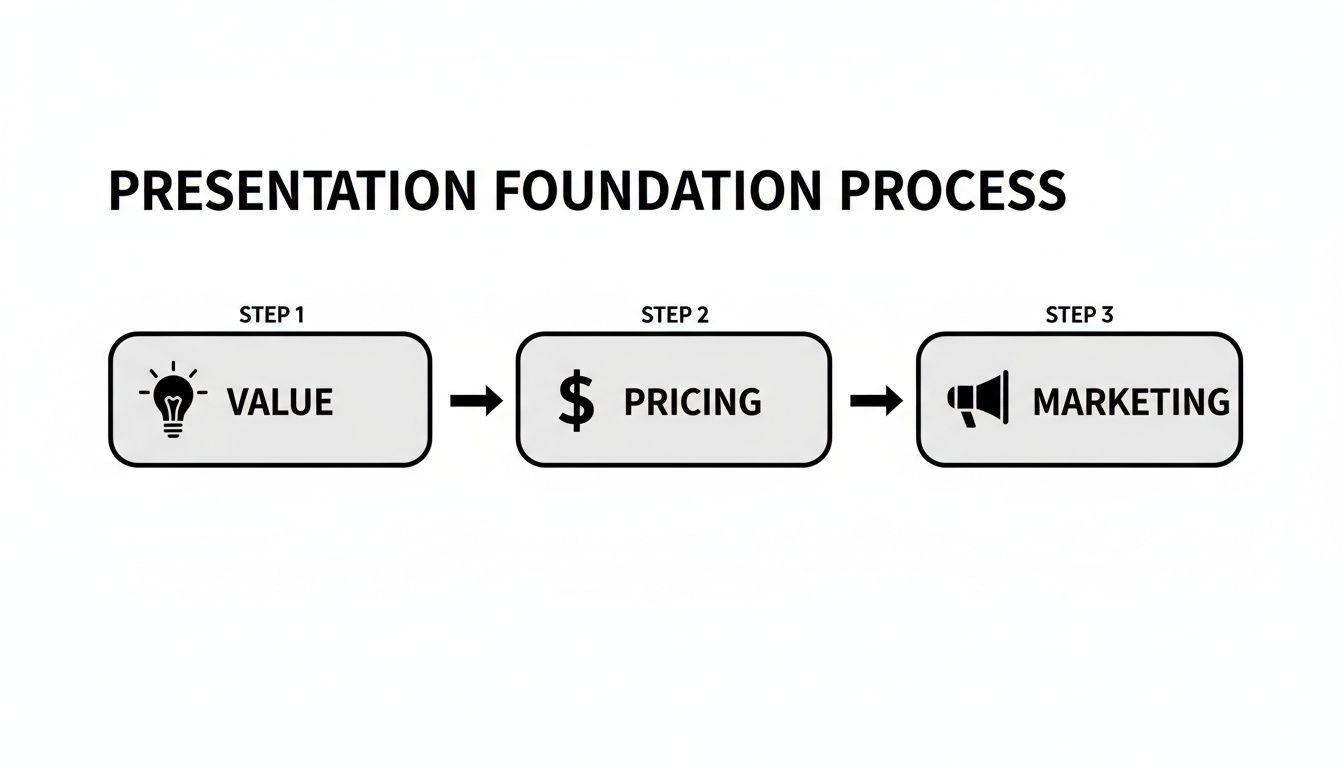
Think of it this way: each part builds on the last, logically guiding the seller from "who are you?" to "let's do this."
The Introduction and Your Unique Value
This is your first impression. The goal isn't to read them your resume; it's to connect quickly and show them why you're not like every other agent they might talk to.
- Slide Title Example: "A Strategic Partner for Your Home Sale"
- Content: Keep it clean. A professional headshot, your brokerage logo, and three powerful bullet points that summarize what makes you different. Steer clear of vague statements like "I'm a hard worker."
- What to Say: "Thanks so much for having me. Before we jump into the numbers, I just want to quickly share what makes my approach a bit different. I focus on [Your UVP #1, e.g., a data-driven marketing strategy], which lets me [Benefit #1, e.g., target the most qualified buyers online]..."
Understanding Your Client's Goals
This is the most important slide in your deck, period. It immediately proves you were listening during your initial phone call and shifts the focus from you to them. It turns a generic pitch into their personalized plan.
Expert Tip: Before you even open your laptop, kick off the meeting by confirming what you heard. Try something like, "Based on our call, it sounds like your top priorities are selling within the next 60 days and getting the most out of this sale for your move to Texas. Did I get that right?" This one small step builds a mountain of trust right from the start.
The Current Market Reality
Now you're setting the stage for the pricing conversation to come. You're not revealing your suggested price yet—you're being the expert, educating them on the market forces that will impact their sale.
- Slide Title Example: "A Snapshot of Our Local Market"
- Content: Use simple, easy-to-read graphics. Show key metrics like "Average Days on Market," "Months of Supply," and the "Sale-to-List Price Ratio" for their specific neighborhood or zip code.
- What to Say: "Right now in your area, we're seeing homes sell for 98.7% of their asking price on average. That tells us that getting the price right from day one is absolutely critical. The homes that are priced correctly from the start are the ones getting swarmed by serious buyers."
Your Custom Marketing Strategy
This is where you pull back the curtain on your action plan. The key here is not just to list what you do, but to explain the benefit behind each step. It’s also the perfect place to show off any unique tools you use, like creating engaging video tours from still photos with a platform like AgentPulse.
Example Marketing Commitments
- Professional HDR Photography: We’ll bring in a pro to capture a minimum of 35 high-resolution photos. With 97% of buyers starting their search online, this ensures your home’s best features truly stand out.
- Cinematic Video Tour: We'll create a dynamic walkthrough video designed to grab attention on social media and Zillow, helping buyers form an emotional connection before they even step inside.
- Targeted Digital Ad Campaign: I will personally run a dedicated social media ad campaign for your listing, reaching a minimum of 20,000 potential buyers within a 15-mile radius based on their online search habits.
This approach shows you have a tangible, proactive system. You're not just making passive promises; you're launching a campaign designed to get their home sold for top dollar.
Telling a Story with Market Data
This is your moment to shift from the friendly agent they've been chatting with to the undeniable local market expert. Let's be honest, anyone can pull a list of comps. What sets a top agent apart is the ability to weave those raw numbers into a clear story that makes your entire strategy feel like the only logical choice.
The goal isn't to bury the seller in spreadsheets. It's to educate them. You want to walk them through the data so clearly and confidently that they arrive at your recommended price on their own. When you do this right, you build a level of trust that no competitor can easily break.
Beyond Just Listing Comps
A truly effective Comparative Market Analysis (CMA) is more than a list of what sold down the street. It tells a story with a beginning, a middle, and an end. Think of it as showing them what’s happening now, what just happened, and—just as importantly—what failed to happen. This approach gives them a complete, 360-degree view of the market forces at play.
To build this narrative, I always organize my data into these four categories:
- Active Listings: This is their live competition. I frame it this way: "These are the homes buyers will be looking at right alongside yours the minute we hit the market."
- Pending Sales: This is the freshest data you have. It shows what buyers are willing to pay right now, today, under the current market conditions. It's your most accurate pulse on present value.
- Sold Listings (within 3-6 months): This is the hard evidence of what the market has recently paid. These are the closed sales that appraisers will be looking at closely.
- Expired & Withdrawn Listings: Honestly, this might be the most crucial part of your story. These homes represent the market’s ceiling. They show the price points and conditions that buyers flat-out rejected.
Visualizing the Data for Clarity
Remember, your clients aren't data analysts. Walls of numbers are intimidating. Your template needs to feature simple, clean visuals that make your point instantly. You don't need fancy software; a basic bar chart or line graph can be incredibly effective.
For instance, a simple chart showing the original list price versus the final sale price for recent solds is a powerful way to show the real cost of overpricing. Telling a seller the average sale-to-list price ratio in their neighborhood is 98.2% is far more convincing than just saying, "We need to price it right."
Pro Tip: I love using a one-page "Market Snapshot" slide. It’s a clean visual with 3-4 key metrics like Average Days on Market, Months of Supply, and that Sale-to-List Price Ratio. It gives them a bird's-eye view before you zoom in on the specific comps.
Crafting the Pricing Narrative
After you've shown them the visuals, it’s time to connect the dots. Don't just throw a number out there. Explain the why. Walk them through the story the data has just told you.
I usually start with the sold properties to establish a solid value range. Then, I bring in the active listings to show exactly where we need to position their home to stand out. Finally, I use the expired listings as a cautionary tale of what not to do.
You could say something like: "Based on what we're seeing, homes priced under $550,000 are going under contract in about 18 days. But notice these two homes that aimed for $580,000? They both sat for over three months and never sold. That's why my strategy is to price at $549,900. We'll capture all those motivated buyers from day one and create immediate momentum."
This turns a dry report into a collaborative strategy session, cementing your role as the expert they can't afford to go without.
Designing a Presentation That Reflects Your Brand

Once you've got your story and all the data lined up, it’s time to wrap it in a package that screams "professional." Let's be honest: even the most brilliant marketing plan can get lost if it's presented on sloppy, thrown-together slides. The design of your listing presentation is a direct preview of the quality and attention to detail a seller can expect from you.
Think of it this way—your presentation is one of the first real glimpses a potential client gets into your work. A clean, modern, and consistently branded design instantly communicates that you’re competent and on top of your game. You don't have to be a graphic designer to pull this off; it's all about building a cohesive visual identity that builds trust from the very first slide.
Establishing Your Brand Identity
Your brand is so much more than just your logo. It's the unique combination of colors, fonts, and imagery that makes you instantly recognizable. The key here is consistency. Every single slide needs to feel like it belongs, reinforcing your professional brand from beginning to end.
To get started, let’s lock down your core brand elements:
- Logo: Make sure you have a high-resolution version. Pop it in the same corner on every slide for a consistent, professional touch.
- Color Palette: Don’t go crazy. Stick to two or three primary brand colors and use them for headings, accents, and charts to create a unified look.
- Typography: Choose two professional, easy-to-read fonts—one for your headlines and a different one for your main text. Steer clear of anything too fancy or hard to read.
This basic framework creates a visual rhythm that makes your presentation easy to follow and, more importantly, memorable. Your branding is a huge part of what sets you apart. For a deeper dive, check out our guide on how to stand out as a real estate agent for more ideas.
Simple Design Principles for Clean Slides
You don’t need an art degree to create a presentation that looks fantastic. In fact, the best designs are often the simplest ones. Your goal is to be clear and readable, not to blind the seller with wild animations or layouts packed with text.
A cluttered slide signals a cluttered mind. Give your content room to breathe by embracing white space. It helps guide the seller’s eye to the most important information and makes complex data feel less intimidating.
Focus on creating a layout that feels natural to look at. Put the main takeaway right at the top of the slide, and use high-quality images and simple icons to break up blocks of text.
For example, instead of just a boring bulleted list of your marketing plan, use clean icons for things like "Professional Photography," "Social Media Blitz," and "Open House." This makes the information pop and helps sellers digest it in a single glance. It’s a small change that turns your presentation from a document into a powerful visual tool that shows you mean business.
Showcasing Your Unbeatable Marketing Plan

This is your moment to turn abstract promises into a rock-solid plan. Let’s be honest, sellers have heard it all before. Vague assurances about "social media posts" and "an open house" are just noise. Your real estate listing presentation template needs to detail your exact strategy with specific, measurable commitments.
You're not just telling them you'll market their home; you're showing them the machine you've built to get it sold. Think of it as pulling back the curtain and revealing a powerful system designed for one purpose: getting their property sold fast and for top dollar.
From Vague Promises to Tangible Actions
The secret is to stop talking about services and start presenting a multi-channel campaign. Instead of saying you use social media, reframe it. Talk about your "14-day launch campaign designed to reach 20,000+ potential buyers" right in their area. See the difference? That small shift in language changes everything.
Here’s how to frame your commitments so they land with real impact:
- Professional Photography: Don't just say "photos." Promise "a minimum of 35 high-resolution photos" to capture every angle. Explain that in today's market, high-quality visuals are the cost of entry.
- Video and Virtual Tours: Get specific. A "2–4 minute cinematic walkthrough video" sounds leagues better than a generic "video tour." You can even mention how you create stunning videos from listing photos using platforms like AgentPulse.
- Digital Advertising: Numbers matter here. Commit to a "7–14 day social media launch with 10–30k paid ad impressions targeted to likely local buyers." This proves you have a proactive, well-defined strategy. For a deeper dive, check out our guide on real estate agent marketing strategies.
When you present your marketing plan with concrete KPIs, you stop selling a service and start selling a predictable outcome. You're showing the seller you have a repeatable system for success.
Putting It All Together in Your Template
Your presentation needs at least one full slide dedicated to this marketing overview. Keep it clean. Use icons and bullet points to make the information scannable and easy to remember.
The new standard is a comprehensive package. I'm talking about syndication to the MLS and 50+ major portals, multiple professional photos for every room, a polished walkthrough video, and a clearly defined social media launch campaign. You can find more insights on what's expected in modern listing presentations at OKZest.com.
This detailed approach builds incredible confidence. It shows sellers you aren't just winging it—you have a proven, powerful system ready to go to work for them.
Presenting and Nailing the Delivery
You’ve put in the work. Your listing presentation is built, branded, and packed with compelling data. Now for the moment of truth: the delivery. Honestly, the most gorgeous slides in the world won’t win you the listing if you don’t project total confidence and expertise.
Think about how you'll present it. What fits your style and, more importantly, the client's vibe? A slick digital deck on a tablet or laptop feels modern and interactive. You can use tools like Canva or PowerPoint to zoom into market stats or even pull up a video tour on the spot. It keeps the conversation flowing.
Then again, there's something to be said for a professionally printed and bound presentation. It feels substantial, premium. It's a physical thing they can hold onto and look through again after you've gone, which keeps you top of mind. Many of the best agents I know actually use a hybrid approach.
The Digital Deck vs. The Leave-Behind
Why choose one when you can have the best of both? The most effective strategy I've seen is using a sharp digital presentation during the meeting and leaving behind a more detailed, printed booklet. This two-part system is catching on for a reason.
Your live presentation should be concise, maybe 12 to 18 slides max. The goal is to keep the seller engaged and guide the conversation, not bore them to tears with data. But the leave-behind? That’s where you can go deep. A comprehensive 50 to 65-page booklet lets them dig into the market analysis and your marketing plan on their own time.
This approach just makes sense. Sellers might skim your deck on their phone initially, but when it’s time to make a final decision, they’ll want that thorough packet to review. If you need some inspiration for modern designs, this Etsy guide for agents has some great ideas.
The Winning Combo
- Live Digital Deck: Keeps the meeting interactive, conversational, and on point.
- Printed Leave-Behind: Shows your depth and diligence, giving them all the details to review later.
Handling Tough Questions Like a Pro
No matter how buttoned-up your materials are, you're going to get hit with tough questions about your commission or pricing strategy. This is where your prep work really shines.
- When they ask about commission: Don't get defensive. The key is to frame your fee as value, not cost. Guide them right back to your marketing plan slide and confidently explain the extensive work and investment you make to get them the highest possible price. Show them the "why" behind the number.
- When they push back on your suggested price: Revisit your CMA data. You're on their team. Try saying something like, "I completely understand wanting to get the highest price possible. Let's take another look at what the market data is telling us about what buyers are actually paying right now."
This kind of calm, data-backed response turns a potential argument into a chance to prove your expertise. It ensures your delivery is every bit as impressive as your presentation materials.
Transform your listing photos into stunning, scroll-stopping videos in minutes with AgentPulse. Elevate your marketing and win more listings without the need for expensive shoots or complicated software. See how it works at https://www.agentpulse.ai.