
What Is Real Estate AI Software?
Think of real estate AI software as a team of super-powered assistants working for you 24/7. It’s not about robots replacing agents. It's about smart tools that handle the repetitive, time-consuming tasks with incredible speed and accuracy, freeing you up to focus on what actually matters: building client relationships and closing deals.
At its heart, this technology uses artificial intelligence—algorithms trained on huge amounts of property data, images, and text—to do some pretty complex things. Imagine feeding a computer thousands of successful property listings. After a while, it starts to learn what makes a description compelling, which camera angles make a room look bigger, and how market trends should affect a price.
This isn't just some far-off theory; it's happening right now and quickly becoming a core part of the modern real estate business.
The Digital Assistant Analogy
A great way to wrap your head around real estate AI software is to picture a highly skilled digital assistant. This isn't your basic calendar or calculator. This is an assistant with deep expertise in marketing, data analysis, and even client communication.
For instance, instead of spending hours or days waiting for a videographer, you can just hand your AI assistant a folder of property photos. In minutes, it analyzes them, picks out the best features, and spits out a professional marketing video with slick camera movements and background music. This is exactly what tools like AgentPulse are built for. You can find out more about the specific applications in our detailed guide on AI for real estate marketing.
This assistant can also play other roles:
- An Interior Designer: Instantly furnishing an empty room with virtual staging to help buyers see themselves living there.
- A Market Analyst: Sifting through thousands of comps and market data points to nail the perfect listing price.
- A Copywriter: Writing engaging property descriptions that grab attention and get more clicks.
This technology lets agents get done in minutes what used to take days. It takes on the tedious, data-heavy lifting, so you can focus on the uniquely human skills of negotiation, empathy, and strategic advice.
Why It Matters Now More Than Ever
Putting these smart tools to work isn't just a fleeting trend; it's a major shift in how the industry operates. The real estate IT market, which fuels all this, is expected to jump from USD 12.56 billion to USD 18.45 billion by 2031. Brokerages that are already using AI are seeing real results—some are saving 70-95% of the time they used to spend on routine tasks and are boosting lead conversions by up to 15%. You can dig into these trends over at Mordor Intelligence.
In the end, this software gives you a serious competitive edge. It helps agents, brokers, and marketers create better listings, respond to leads faster, and make smarter, data-backed decisions. By automating the mundane and optimizing the complex, real estate AI helps you deliver better service and drive better results for your clients.
The Core Capabilities of Modern Real Estate AI Tools
So, what does this technology actually do for you on a day-to-day basis? It's easy to get lost in the buzz, but real estate AI software delivers specific, powerful tools that solve some of an agent's biggest headaches. These aren't abstract concepts; they’re designed to automate tedious marketing, make your listings look incredible, and give you data-backed insights in a fraction of the time it used to take.
Think of it less like a single, all-knowing program and more like a Swiss Army knife for your real estate business. Each tool has a distinct purpose, whether it's whipping up the perfect listing description or figuring out the most competitive sale price. Let's break down the five game-changing capabilities that are truly changing how we market and sell properties.
Automated Video Creation from Still Photos
One of the most immediate and impressive things real estate AI software can do is turn a simple gallery of property photos into a dynamic, engaging video tour. We all know how much time and money it used to take to create a high-quality video—hiring a videographer, scheduling a shoot, and then waiting for all the editing to be done.
AI flips that entire process on its head. Now, you can just upload your standard listing photos, and the software takes over. It’s smart enough to analyze each image, understand the room's layout, spot key features like a cozy fireplace or a great view, and then generate smooth, professional camera movements. The result is a high-end video with pans, zooms, and transitions that make it feel like you’re actually walking through the home.
By transforming static images into engaging video content, AI democratizes video marketing. It allows any agent to create compelling social media reels, MLS video listings, and ad content in minutes, not days.
Virtual Staging and Digital Renovation
An empty home is a blank canvas, but let's be honest—for most buyers, it’s a canvas that’s hard to visualize. Virtual staging completely solves this problem. It uses AI to digitally furnish and decorate photos of vacant properties, showing off a home's full potential without the cost and hassle of hauling in real furniture.
The technology has gotten incredibly good. AI can:
- Add Furniture: Populate an empty living room with a stylish sofa, coffee table, and rug that perfectly match the home's vibe.
- Change Flooring or Wall Color: Show potential buyers exactly how the space would look with modern hardwood floors instead of old carpet.
- Perform Minor Renovations: Virtually knock out a non-load-bearing wall to show off a potential open-concept layout.
This concept map shows how core AI capabilities like staging, marketing, and pricing all connect back to a central AI engine.
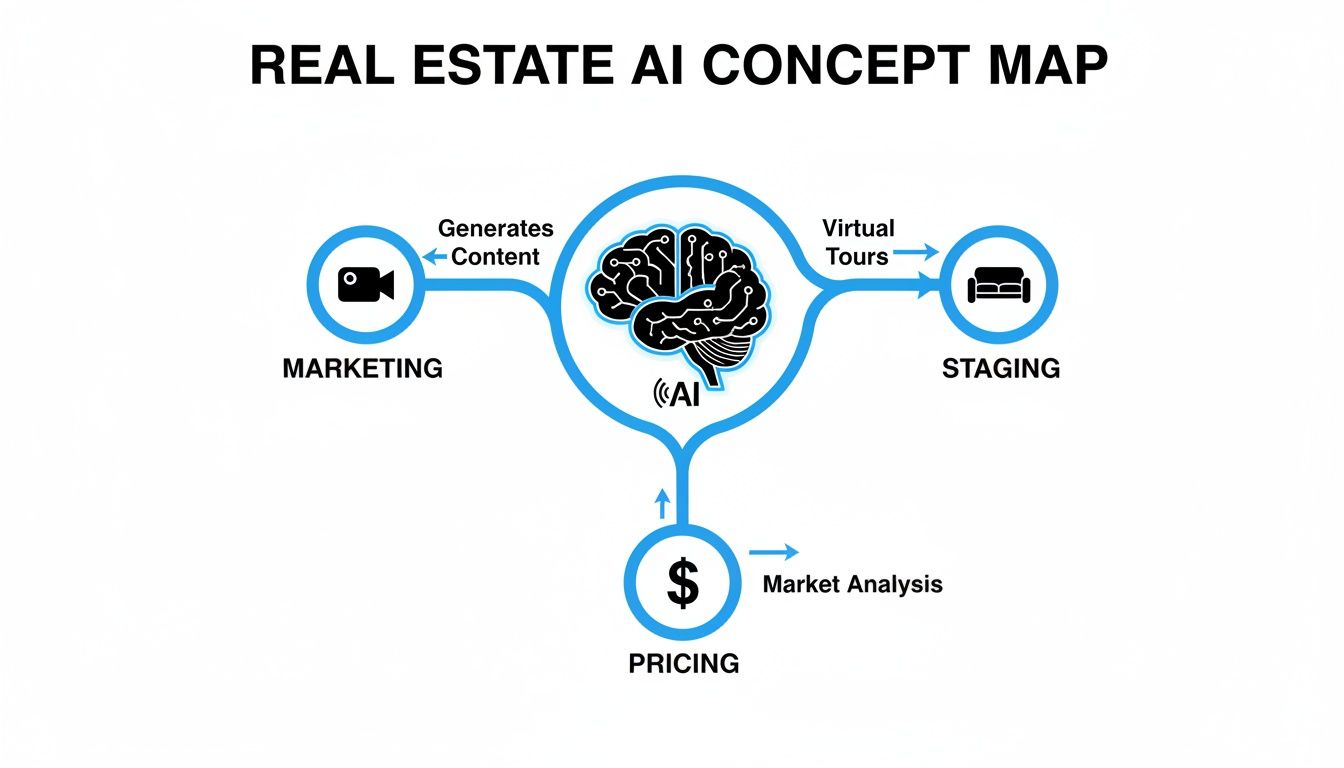
It’s a great visual for understanding how one technology can support so many critical real estate functions at once.
AI-Powered Copywriting and Listing Optimization
Writing property descriptions that are both compelling and optimized for search engines is a real art form. AI copywriting tools act like your personal writing assistant, generating fantastic listing text from just a few key property details.
All you have to do is input the basics—bedrooms, bathrooms, square footage, and unique features like "newly remodeled kitchen with quartz countertops." The AI then gets to work, crafting several versions of a description, each with a slightly different tone. It can play up a home’s cozy charm for a family or its sleek, modern amenities for a young professional, making sure the language connects with the right audience.
Intelligent Chatbots for Lead Qualification
That window to connect with a new lead is frustratingly small. AI-powered chatbots on your website or social media profiles provide instant, 24/7 responses to anyone who reaches out. And these aren't the clunky, robotic bots from a few years ago; today's chatbots can handle surprisingly complex conversations.
For instance, a potential buyer might ask, "Does the property at 123 Maple Street have a fenced-in yard?" The chatbot can instantly pull that data from the listing and give an accurate answer. It can also ask smart qualifying questions like, "Are you already working with an agent?" or "When are you hoping to move?" This way, by the time a lead gets to you, they're already warmed up and qualified.
Predictive Market Analysis and Pricing
Setting the right price from the get-go is everything. AI-driven predictive analytics models dig through massive datasets, including historical sales, current market trends, neighborhood stats, and property-specific details to find the pricing sweet spot.
This goes way beyond a standard comparative market analysis (CMA). An AI pricing tool can spot subtle patterns a human might easily miss, giving you a highly accurate valuation and even forecasting potential appreciation. This data-first approach lets you advise your clients with total confidence, helping them price their properties to sell faster and for the best possible number.
To quickly see how these tools fit into different roles, here’s a simple breakdown:
AI Software Capabilities for Real Estate Professionals
| AI Capability | Primary Use Case | Key Benefit |
|---|---|---|
| Automated Video Creation | Turning listing photos into social media reels and video tours. | Saves significant time and money on video production. |
| Virtual Staging | Digitally furnishing empty rooms in property photos. | Helps buyers visualize the space and increases emotional appeal. |
| AI Copywriting | Generating compelling, search-optimized property descriptions. | Overcomes writer's block and creates better marketing copy, faster. |
| Intelligent Chatbots | Providing 24/7 automated responses and lead qualification. | Never miss a lead and focus your time on qualified buyers. |
| Predictive Pricing | Analyzing market data to determine the optimal listing price. | Price listings more accurately for a quicker, more profitable sale. |
Each of these capabilities offers a practical solution to a real-world problem, making your job easier and your marketing more effective.
How AI Delivers a Measurable Return on Investment
Let's be honest, adopting new technology is only worth it if it actually helps your bottom line. Investing in real estate AI software isn't just about having the latest gadget; it's a smart business decision that can deliver real growth and a serious competitive advantage by improving the numbers you already watch every day.
It all comes down to connecting the dots. When you use a tool that creates a listing video automatically, you're not just saving time. You're freeing yourself up to focus on what really matters: closing deals and serving your clients.

Driving Down Time on Market
One of the most obvious ways AI pays for itself is by helping you sell properties faster. A listing that lingers on the market is a drain on your resources and a source of stress for your clients. AI comes at this problem from a few different angles, all of which help lower your Time on Market.
The biggest impact comes from better marketing materials. AI tools can whip up engaging video tours from a handful of listing photos in minutes. These videos are exactly what buyers are looking for on social media and the MLS. On top of that, virtual staging can make an empty house feel like a home, which makes buyers 40% more likely to book a viewing.
When your listings are more engaging and easier for buyers to visualize, you naturally get more serious inquiries right from the start. More interest means more showings, which leads to more offers and a quicker sale.
Improving Lead Quality and Conversion Rates
It's not just about getting more leads—it's about getting the right ones. AI-powered chatbots can work around the clock, answering basic questions and screening potential buyers before they ever get to you. This initial vetting means that when your phone finally rings, the person on the other end is far more likely to be a serious, motivated buyer.
This directly boosts two of your most important metrics:
- Cost Per Lead (CPL): By letting AI handle the initial sorting, you spend less time and money chasing down people who are just casually browsing. Your cost to find a truly qualified lead drops.
- Lead Conversion Rate: Because you’re spending your time with people who are already warmed up and pre-qualified, your chances of turning that conversation into a signed contract go way up.
This is all about smart allocation. AI software helps you maximize ROI for real estate professionals by making sure your marketing dollars are spent on people who are actually ready to move.
Maximizing Efficiency and Profitability
There's a reason the real estate AI market is on track to become a $1.3 trillion industry by 2034. The efficiency gains are just incredible. Agents and brokers already using these tools report spending 70-90% less time on manual busywork, while hitting accuracy rates over 95%.
Think about it: every hour you save writing listing descriptions or following up on cold leads is an hour you can spend nurturing a relationship with a high-value client or negotiating a better deal.
Here’s a quick breakdown of how that efficiency translates directly to profit:
- Reduced Marketing Spend: You can skip the expensive videographer or stager. Let AI create your videos and virtually stage your listings for a fraction of the cost.
- Increased Productivity: Imagine automating listing descriptions, social posts, and initial lead responses. A single agent can suddenly handle a much larger pipeline without getting overwhelmed.
- Data-Backed Pricing: AI analytics help you price a home correctly right out of the gate, preventing the need for frustrating price drops down the line and ensuring you get the best possible sale price.
At the end of the day, investing in the right AI software is about making your business smarter, faster, and more profitable. It lets you step away from the tedious tasks and focus on the strategic work that truly grows your business.
Choosing the Right Real Estate AI Software for Your Needs
With so many AI tools hitting the market, picking the right one can feel overwhelming. The secret is to cut through the hype and zero in on what will actually move the needle for your business. It's not about finding the software with the longest feature list; it’s about finding the one that solves your biggest headaches simply and effectively.
To make a smart choice, you need a solid game plan. Think of it like helping a client find their perfect home. You’d start with a checklist of must-haves and nice-to-haves to make sure the final choice fits their needs and budget. Applying that same logic here will help you pick a platform that delivers real, tangible value.
Start with User-Friendliness
The most powerful software in the world is completely useless if your team can’t figure out how to use it. A steep learning curve will kill adoption before you ever see a return on your investment. Look for a tool with a clean, intuitive interface and a workflow that just makes sense.
Can you figure out how to do the main things without calling a developer or getting lost in video tutorials? Most platforms offer free trials or demos—take advantage of them. Getting your hands on the software is the best way to tell if a particular real estate AI software will blend into your daily routine or just become another subscription you forget about. The goal is to find tech that feels like a helpful assistant, not another chore.
Align Core Features with Your Biggest Needs
Not all AI tools are built the same. Some are wizards at creating marketing videos, while others are all about pricing analytics or handling leads. Before you even start looking at options, pinpoint the single biggest bottleneck in your business right now.
- Is marketing eating up all your time? A tool like AgentPulse that automates video creation could be a total game-changer.
- Are your listings failing to pop? Virtual staging software might be exactly what you need.
- Are you drowning in leads that go nowhere? An AI chatbot could be your new best friend.
Focus on platforms that are exceptional at solving your main problem. You can dig deeper into specific solutions in our guide to the best AI tools for real estate agents. This focused approach ensures you're investing in something that will have an immediate, measurable impact.
Choose software that solves a specific, high-value problem for you. A tool that does one thing exceptionally well is often more valuable than a platform that does many things poorly.
Check for Critical Integrations
Your business already runs on a specific set of tools, from your CRM and MLS to your transaction management system. Any new AI tool should play nicely with your current tech stack, not fight against it. Look for ready-made integrations or at least simple ways to get data in and out.
If a tool can’t connect with the systems you use every single day, you’ll end up with frustrating data silos and more manual work. That's the exact opposite of what you’re trying to achieve. For a good overview of solutions with strong integrations, check out this list of the 12 best property management apps for 2025.
Evaluate Pricing and Scalability
Finally, look at the cost versus the value. Is the pricing model straightforward and predictable? You want a plan that can grow with you. A flexible subscription that lets you scale up during the busy season or as your team expands is a huge plus. Make sure there are no hidden fees and that the price tag makes sense for the ROI you expect, whether that’s measured in time saved, lower marketing costs, or faster closings.
Real-World Examples of AI Transforming Listings
It's one thing to talk about what real estate AI software can do, but it's another to see it in action. The real magic happens when these tools solve the everyday headaches that agents, property managers, and hosts face. Let’s look at a few stories that show how this technology is already making a huge difference out in the field.

These aren't some far-off, futuristic ideas. They're practical solutions that are changing how properties are marketed right now. Each story tackles a common challenge and shows how a specific AI tool delivered a fantastic result.
The Agent Who Needed a Video Yesterday
We’ve all been there. Meet Sarah, a top agent with a new listing set to go live in just two days. The photos from her photographer are stunning, but she knows a video is what will really stop the scroll on Instagram and the MLS. But hiring a videographer with no notice? Impossible, not to mention expensive.
Instead of panicking, Sarah used an AI video creation tool. She simply uploaded the folder of high-res photos, typed in the property address for a quick intro, and picked some upbeat background music from the tool’s library.
The AI got to work, analyzing each picture, zeroing in on the best features of every room, and creating those smooth, cinematic camera pans everyone loves. In less than five minutes, she had a polished, high-definition video tour ready to go.
The Outcome: Sarah pushed the AI-generated video to her social media as a Reel. The engagement was immediate. Compared to her usual photo-only listings, she saw a 50% jump in online inquiries in the first 24 hours. The property was under contract in under a week. You can learn more about this process in our guide to creating AI real estate videos.
The Property Manager and the Vacant Unit
Now, let's talk about Michael. He’s a property manager struggling to rent a newly renovated—but totally empty—two-bedroom apartment. It had been sitting on the market for over a month, and the feedback was always the same: people couldn't picture their own furniture in the space.
Physical staging was way too costly for a rental. So, Michael tried an AI virtual staging platform. He uploaded photos of the empty living room, master bedroom, and dining area and then chose a "Modern Farmhouse" style from a menu of options.
The software went to work, digitally adding photorealistic couches, beds, tables, and decor. In less than an hour, the cold, empty rooms were transformed into warm, inviting spaces that showed off the apartment's real potential.
The Outcome: Michael swapped the old photos for the new virtually staged ones in the online listing. The change was night and day. Tour requests tripled almost overnight, and the apartment was leased just ten days later. That’s a huge reduction in vacancy time and lost rent.
The Airbnb Host Standing Out from the Crowd
Finally, picture Chloe, an Airbnb host whose downtown condo was getting lost in a sea of similar listings. She had great photos, but so did everyone else. She needed something to make her property pop.
Chloe decided to use a couple of AI tools. First, she turned her listing photos into a quick, dynamic video to use in her social media ads. Next, she fed her property details—like "walkable to restaurants," "rooftop pool," and "dedicated workspace"—into an AI copywriting tool. The AI rewrote her listing description to be more compelling and benefit-focused, speaking directly to business travelers and weekend visitors.
The Outcome: The new video and professionally polished description worked. Chloe's listing started climbing in Airbnb's search results, and her booking rate shot up by 30% over the next three months. She was even able to increase her nightly rate a bit. These stories are part of a massive trend, with the generative AI market in real estate expected to reach USD 1,427.36 million by 2035, all thanks to tools that deliver these kinds of tangible wins.
Got Questions About Real Estate AI? We’ve Got Answers.
It's completely normal to have questions when you're looking at a new piece of technology. When that tech involves something as fundamental as AI, you want clear, straight-up answers. Let's tackle some of the most common things agents and brokers ask.
Is This AI Stuff Hard to Learn?
That’s usually the first question, and the answer is a relieving "no." Modern real estate AI software is built for busy agents, not tech wizards. The whole point is to make your job easier, not to give you another complicated system to wrangle.
Most platforms have clean, simple dashboards. Think drag-and-drop simple. Creating a marketing video, for instance, is often just a matter of uploading your photos and clicking a single button. The best tools are designed to feel intuitive from the moment you log in, often with free trials and plenty of support to help you get comfortable fast.
Is AI Going to Take My Job?
Let's clear this one up right away: absolutely not. AI is a tool, not a replacement. Think of it like a super-powered assistant—it's there to handle the tedious, time-consuming tasks so you can focus on what you do best.
AI is great at crunching numbers, writing a first draft of a listing description, or editing a video. But it can’t build a relationship, earn a client's trust, or navigate the delicate emotions of a high-stakes negotiation. Your expertise and personal touch are what close deals, and that’s not changing.
What Does Real Estate AI Software Actually Cost?
The price range is all over the map, which is actually a good thing—it means there’s an option for just about any budget. The pricing is usually set up to be flexible, so it can grow with your business.
Here are the models you’ll most often see:
- Free Trials or Freemium Tiers: A lot of tools will let you try out the basic features for free. You might have a watermark on your video or a limit on how many listings you can work on, but it's a great way to test the waters.
- Monthly or Annual Subscriptions: This is the most common setup. You’ll find different plans based on how much you use the tool or which advanced features you need. A starter plan might cost less than your monthly coffee budget, while a full-blown agency plan will be a more significant investment.
The main takeaway is that you don’t need a huge upfront investment. Powerful AI tools are more accessible than ever and are built to deliver a real return on your money by saving you time and boosting your marketing.
Ready to see how easy it is to make your listings stand out? With AgentPulse, you can turn your property photos into engaging, professional-quality videos in minutes. Try it for free and create your first video today!