Pricing a rental property is all about finding that sweet spot between maximum profit and minimal vacancy. It’s a delicate dance of market research, expense tracking, and smart positioning to land the right tenants at the right price. The whole game boils down to analyzing local comps, figuring out what makes your property special, and running the numbers to make sure it's actually profitable.
Finding Your Property's Perfect Price Point
Setting the right rent is part art, part science. Just guessing or slapping on the same price as the unit down the street is a rookie mistake that can easily cost you thousands in lost income or, even worse, long vacancies. A one-size-fits-all approach just doesn't work; every property, neighborhood, and local market has its own pulse.
The starting line for smart rental pricing is always a deep dive into your local market, getting way beyond just surface-level assumptions. This is how you establish a competitive and realistic baseline. You’ll need to analyze comparable properties—we call them "comps"—but you have to do it with a critical eye. It's not about just finding any three-bedroom house in your zip code. You need to find properties that are a true reflection of yours in size, condition, and amenities.
Identify Your Property's Unique Value
Once you've got a baseline from your comps, it's time to figure out what makes your property stand out from the crowd. These unique selling points are your leverage to justify a higher price and attract the best tenants.
Think about what you've got that the others don't:
- Recent Upgrades: Did you just gut the kitchen and put in new appliances? What about modern bathrooms or new flooring? These matter.
- Desirable Amenities: Things like an in-unit washer and dryer, a private backyard, a garage, or even a good-sized storage closet add real value.
- Location Perks: Is your property a short walk from the train, a popular park, a great school, or the downtown hot spots? That convenience commands a premium.
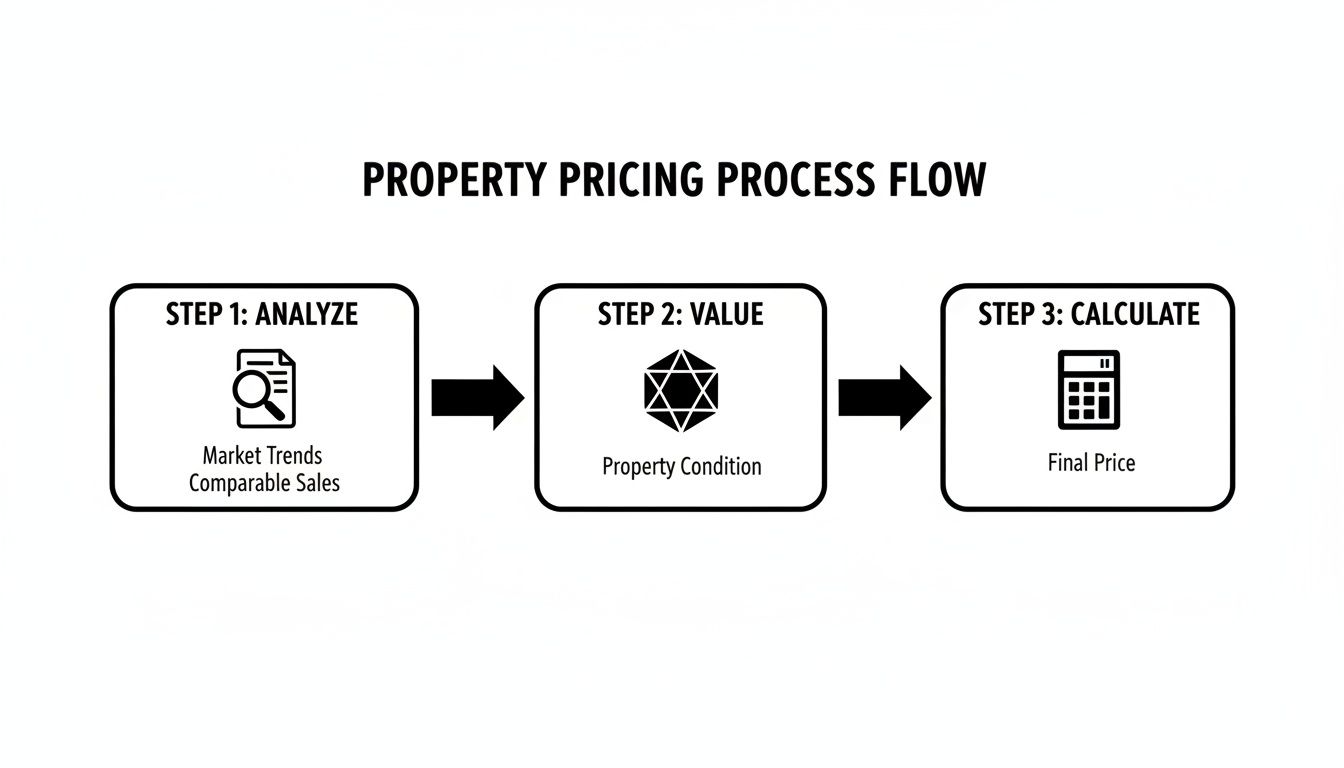
This process—analyzing the market, valuing your property's unique features, and then calculating the final price—is a repeatable framework for getting it right every time.
Factor In Your Financial Goals
Knowing the market is only half the story. You also have to nail down your own numbers, including your operating expenses and what kind of return on investment (ROI) you're aiming for. This ensures your rent doesn't just fill the unit but also builds a profitable asset for you.
With the global real estate market projected to rocket past $7 trillion by 2034, more and more investors are zeroing in on rental properties that can generate steady cash flow. Housing shortages and demographic shifts are keeping rental demand strong, which makes pricing accurately more crucial than ever.
To make sure your property is a top performer, it pays to learn how to price rental property like a pro.
Get to Know Your Local Rental Market Inside and Out
Setting the right rent isn't just about picking a number that sounds good. It comes from an almost obsessive understanding of your local market. Too many landlords just glance at Zillow or copy the listing down the street, but that’s just guessing. To truly nail how to price a rental property, you need to dig in and do a proper market analysis. This is what gives you the data to price with confidence and stay competitive.
The whole process starts with finding your "comps"—comparable properties. A true comp isn't just another two-bedroom in the same zip code. It's a place that a real, live-and-breathing tenant would seriously consider as an alternative to yours.
Finding Your True Comparables
Your first mission is to track down three to five recently rented properties that are as close a match to yours as possible. The trick is to be ruthless with your filters. Look past the basics and focus on the little details that actually sway a renter's decision.
Here’s what you should be looking for:
- Property Type: Apples to apples. Compare your single-family home to other single-family homes, not condos.
- Square Footage: Keep it tight—look for properties within 10-15% of your unit’s size. A cozy 900 sq ft apartment is in a totally different league than a 1,500 sq ft one.
- Bedrooms & Bathrooms: Stick to the exact same count. That extra half-bath can make a surprising difference in what you can charge.
- Age & Condition: Be brutally honest here. A freshly renovated unit with modern finishes simply can't be compared to one that still has a kitchen from the 1980s.
- Location: Zoom in. We're talking about the same neighborhood, maybe even the same block. Things like being close to a great park, a bus stop, or a top-rated school create tiny micro-markets.
- Amenities: Does your place have in-unit laundry, a private yard, garage parking, or central AC? These are the features that get tenants to sign a lease.
You can pull this data from places like your local MLS (if you have access), Zillow, and Apartments.com. I also really like specialized tools like Rentometer for a quick gut check. And don't sleep on local property management websites—they're a goldmine for current rental rates.
The Art of Adjusting for Differences
Let's be real: no two properties are ever identical. The real skill is learning how to put a price on those differences. This is where you move from just gathering data to actually analyzing it.
Think like an appraiser. If your unit has a brand-new, high-efficiency HVAC system but the comp has an older one, your property can command a bit more. If a comparable has a two-car garage and you've only got street parking, you’ll need to adjust your price down to compensate.
Pro Tip: Try assigning a dollar value to your best amenities. In my market, in-unit laundry can easily add $50-$75 per month to the rent. An assigned parking spot in a crowded neighborhood? That could be worth $100 or more.
To keep things objective, I find a simple worksheet is a huge help. It forces you to compare your property feature-by-feature against your comps and assign a real dollar value to each difference.
Here’s a sample worksheet you can use to make this process less of a guessing game and more of a science.
Rental Comps Adjustment Worksheet
| Feature | Your Property | Comp 1 (Price) | Comp 1 Adjustment (+/-) | Comp 2 (Price) | Comp 2 Adjustment (+/-) | Comp 3 (Price) | Comp 3 Adjustment (+/-) |
|---|---|---|---|---|---|---|---|
| Rent Price | (Your Target) | $1,850 | $1,950 | $1,800 | |||
| Sq. Footage | 1,100 | 1,050 | +$25 | 1,200 | -$50 | 1,100 | $0 |
| Bedrooms | 2 | 2 | $0 | 2 | $0 | 2 | $0 |
| Bathrooms | 2 | 2 | $0 | 2.5 | -$40 | 2 | $0 |
| Kitchen | Renovated | Similar | $0 | Original | +$75 | Renovated | $0 |
| Parking | 1-Car Garage | Driveway | +$50 | 1-Car Garage | $0 | Street Only | +$100 |
| Laundry | In-Unit | In-Unit | $0 | In-Unit | $0 | Basement | +$50 |
| Yard/Patio | Small Patio | Fenced Yard | -$30 | No Patio | +$40 | No Patio | +$40 |
| Adjusted Rent | $1,895 | $1,975 | $1,990 |
After filling this out, you get an adjusted rental price for each comparable. Averaging these numbers gives you a powerful, data-backed starting point for your own property. In this case, the average is around $1,953.
This level of detail is critical because the rental market is always in flux. While global trends are one thing, what's happening on your street is what really matters. Sure, the 2026 Global Occupier Outlook from Savills shows that 69% of occupiers expect rents to rise globally, but the local picture can be wildly different. U.S. rent growth is expected to settle around 2.0% in 2026, but some markets in the Northeast might see 4-5% growth while parts of the Sun Belt could be flat.
Reading the Broader Market Conditions
Beyond individual properties, you need a feel for the neighborhood's overall health. Are there "For Rent" signs on every corner? That’s a tenant's market, and you might need to price more aggressively or throw in an incentive. If nothing is available, you’re in a landlord's market and have more leverage.
Check local real estate reports or, even better, chat with a few local property managers. Ask about the current vacancy rate and the average days on market (DOM) for rentals like yours. If similar units are getting snapped up in under two weeks, the market is hot. If they're sitting empty for a month or more, you need a more conservative strategy to avoid a long and expensive vacancy.
Getting the Numbers Right: The Key to a Profitable Rental
Once you have a solid feel for the local market, it's time to look inward. The market tells you what you can charge, but your own numbers tell you what you must charge to actually make money. This is where you stop guessing and start building a real financial strategy.
Too many landlords make the classic mistake of setting their rent based on the mortgage payment. That's a surefire way to lose money. A profitable rental has to account for every single dollar spent—the obvious, the hidden, and the "oops, I forgot about that" costs.
Nail Down Your Total Operating Expenses
Before you can even think about profit, you need a crystal-clear picture of your operating expenses. These are all the costs of keeping the lights on and the property running, not including your mortgage payment.
I like to break them down into a few simple buckets:
- Fixed Costs: These are your predictable, recurring expenses. Think property taxes, landlord insurance, and any pesky HOA fees. They're pretty much the same month after month.
- Variable Costs: These can fluctuate quite a bit. This bucket includes things like repairs, general upkeep, and utilities (if you're covering any of them for your tenants).
- Big-Ticket Reserves: This one is crucial and often overlooked. You have to save for the major items that will eventually fail. A new roof can run you $8,000-$15,000, and a new HVAC system can easily cost $5,000-$10,000. A good rule of thumb is to sock away 1-2% of the property’s value every year just for these capital expenditures.
Don't forget to budget for vacancy! Even in the best markets, you'll have turnover between tenants. I always advise setting aside 5-8% of the monthly rent to cover those empty periods. It’s a realistic safety net.
Keeping track of all this can get messy fast. Using a dedicated system can be a lifesaver. If you're looking to get organized, you might find our guide on the best software for property managers helpful for streamlining this whole process.
Using Key Metrics to Guide Your Pricing
With your expenses tallied up, you can now use a few industry-standard formulas to check the financial health of your investment. These aren't just for Wall Street types; they give you a quick, clear snapshot of how your property is really performing.
At its core, this all comes down to understanding cash flow in real estate. That’s the actual money you have left over after every single bill is paid. But beyond that simple calculation, two other metrics are incredibly useful for setting your rent: the Cap Rate and the Gross Rent Multiplier.
Using the Capitalization Rate (Cap Rate)
The Cap Rate is a fantastic tool for measuring your property's return relative to what it's worth. You calculate it by dividing your Net Operating Income (NOI) by the property's current market value. Your NOI is just your total rental income minus all of your operating expenses.
- The Formula: Cap Rate = (Net Operating Income / Property Value) x 100
Generally, a higher cap rate suggests a better return, but it can also mean higher risk. It's the perfect way to compare the raw profitability of different properties in a market, without getting financing details mixed in.
Knowing your numbers is more important than ever. The U.S. rental market has seen some wild swings lately. By the end of 2025, the national median rent actually dipped 1% in a single month as the multifamily vacancy rate shot up to a record 7.2%. And the forecast for 2026 shows a huge split: single-family rent growth is projected at 2.3%, while multifamily is expected to stay almost flat at 0.3%. These trends directly impact what you can realistically expect to earn.
A Quick Check with the Gross Rent Multiplier (GRM)
The Gross Rent Multiplier (GRM) is a much faster, simpler calculation. It’s a great way to compare property values based purely on their gross income potential, before you even factor in expenses.
- The Formula: GRM = Property Value / Gross Annual Rent
To use it, you find the GRM for similar properties that have recently sold in your area. Then, you can apply that multiplier to your property to see if its value lines up with the rent you want to charge. It's a great "back-of-the-napkin" sanity check.
For instance, if comps have a GRM of 8 and your property can pull in $30,000 a year in rent, its estimated value is $240,000 (8 x $30,000). This helps you confirm that your asking rent makes sense for a property of that value.
Using Advanced Pricing Strategies to Gain an Edge

Once you've crunched the numbers and landed on a solid, data-backed base rent, the real fun begins. Maximizing your revenue isn't about setting a price and forgetting it. The sharpest landlords I know treat their rental rate as a flexible tool, not a fixed number, allowing them to adapt to market shifts and keep their units filled.
This is where you move from just collecting rent to actively managing your investment for peak profitability. It’s about being proactive and strategic, not just reacting when a unit goes vacant.
Harness the Power of Seasonal Pricing
Everyone knows seasonal pricing is a must for short-term rentals, but it's a surprisingly effective lever for long-term properties, too. The logic is simple: you adjust your rent to match the predictable ebbs and flows of demand throughout the year.
Think beyond beach houses. Is your property in a college town? Demand goes through the roof in late summer as students scramble for a place before the fall semester. A modest rent bump of 5-10% for leases starting in August is completely reasonable. On the flip side, if you find yourself with a vacancy in the dead of winter when fewer people are moving, nudging the price down a bit can be the key to getting it filled fast.
For more insights on this, our guide on how to increase Airbnb bookings has some great tips that apply to almost any rental scenario.
Use Introductory Offers to Fill Vacancies Fast
Nothing kills your cash flow like a vacant unit. It’s a silent drain on your profits every single day it sits empty. During those slower rental months—usually in the winter—a well-timed introductory offer can be the perfect hook to stop the financial bleed.
Here are a few incentives that work like a charm:
- First Month's Rent Discount: Offering 25% or even 50% off the first month can make your property stand out in a crowded market.
- Waived Fees: Getting rid of the application or pet fee is a low-cost way to remove a final barrier for a great applicant who might be on the fence.
- A Freebie: Tossing in a free parking spot for six months or including a premium cable package can be the little extra that seals the deal.
You have to run the numbers, of course. But a one-time discount of $500 is almost always a smarter move than losing a full month's rent of $2,000 or more.
Implement Tiered Pricing for Lease Lengths
Tenant turnover is more than just an inconvenience; it's expensive. Every time someone moves out, you're on the hook for cleaning, repairs, marketing, and the potential cost of vacancy. A smart way to encourage stability is to offer tiered pricing based on the lease term.
For example, your standard 12-month lease might be $2,100 per month. But what if a fantastic applicant is willing to sign for 24 months? Offering them a rate of $2,050 could be a brilliant move. That $50 monthly savings for them is a small price for you to pay to lock in two full years of income and dodge turnover costs after year one.
Pro Tip: Don't underestimate pricing psychology. Listing a unit at $1,995 instead of $2,000 just feels significantly cheaper to prospective tenants, even though it’s a tiny difference. This is called "charm pricing," and it works.
Finally, consider bundling. If you offer extras like a storage unit or a premium parking spot, package them together for a slight discount. This boosts the perceived value and can increase your total revenue from each tenant. By combining these strategies, you can fine-tune your approach and truly master how to price a rental property for maximum profit and minimum hassle.
Marketing Your Rental to Justify Its Value
All that hard work doing comps and crunching numbers leads to one thing: your target rent. But that number is purely theoretical until you can convince a real-life tenant that your place is worth every penny.
You can't expect a premium rent without putting in premium effort on the marketing front. This is where you stop thinking like a mathematician and start thinking like a storyteller. It's time to translate your property’s features into a narrative that justifies the price tag.
So many landlords drop the ball here. They snap a few quick phone pics, write a generic description, and then wonder why they aren't getting top dollar. Your listing is your property's first impression, and its only job is to get high-quality applicants excited enough to pay what you're asking. Great marketing builds perceived value, slashes your vacancy time, and gives you the confidence to hold firm on your price.
Writing Copy That Sells a Lifestyle
Your rental description needs to do more than just rattle off the number of bedrooms and bathrooms. It needs to paint a picture. You’re not just renting out a space; you're selling the life someone could live there.
Think about who you want to attract. Is it a young professional who craves convenience? Maybe a small family looking for a safe, welcoming neighborhood? Your words should speak directly to that person.
For instance, don't just say this:
- "2-bed, 2-bath apartment. New kitchen. Close to train."
Instead, try to create an experience:
- "Imagine brewing coffee in a sun-drenched, brand-new kitchen before an easy 5-minute walk to the train. This spacious two-bedroom, two-bath home is the perfect retreat after a long day, offering the modern comforts you deserve."
See the difference? That small shift turns a bland list of facts into a real lifestyle benefit. It helps potential renters build an emotional connection before they even set foot inside. For a deeper dive, our complete guide on how to market rental properties has even more strategies to make your listings pop.
Visuals Are a Non-Negotiable Investment
In real estate, seeing is believing. A potential tenant’s first encounter with your property will be through a screen, and those first few seconds are critical. It's a known fact that listings with high-quality photos get far more views and inquiries.
Dark, blurry, or crooked photos are an instant turn-off. They don't just make the property look bad; they suggest you're a landlord who cuts corners.
Professional photography isn't a luxury anymore—it's the bare minimum if you want to command top-of-market rent. A pro knows how to use light and angles to make every room look bright, spacious, and inviting. That small investment can pay for itself many times over by attracting a better tenant, faster, and at a higher rent.
Investing in your property's presentation is just as important as investing in the property itself. High-quality visuals don't just show a space; they build trust and communicate professionalism, making tenants more confident in their decision and your asking price.
If you really want to stand out and justify that premium price, a cinematic video tour is your secret weapon. A well-produced video gives people a feel for the home's layout and flow in a way static photos just can't match. It helps them truly picture themselves living there—and that's a huge step toward them happily agreeing to your rent.
The Clear Impact of High-Quality Marketing
It's simple: the effort you put into marketing directly affects your bank account. A low-effort approach almost always results in a lower rent and a longer, more painful vacancy period. Investing in presentation, on the other hand, pays dividends.
The table below breaks down how different marketing choices can dramatically influence your property's perceived value and, ultimately, your financial return.
Marketing Impact on Perceived Rental Value
| Marketing Tactic | Low-Effort Approach (Example) | High-Impact Approach (Example) | Potential Impact on Rent |
|---|---|---|---|
| Listing Photos | Dark, blurry phone pictures taken at awkward angles. | Bright, wide-angle professional photos that showcase each room's best features. | + $50-$150/month |
| Property Video | No video or a shaky, handheld walkthrough. | A smooth, professionally edited video tour with music, highlighting the property's flow and lifestyle. | + $75-$200/month |
| Listing Copy | "3 bed, 2 bath for rent. Call for details." | A detailed, engaging story about the home, neighborhood, and unique benefits. | Fewer Vacancy Days |
| Presentation | Cluttered rooms, poor lighting during showings. | Staged or decluttered spaces, clean, and well-lit for all viewings. | Higher Quality Applicants |
By committing to high-impact marketing, you're not just showing off a rental—you're building a brand for it. This polished presentation naturally attracts serious, qualified applicants who recognize the value you're offering and are less likely to haggle. It’s an essential part of mastering how to price a rental property for maximum profit.
Answering Your Top Rental Pricing Questions
Even after you've run the numbers and done your research, a few nagging questions always seem to surface. It’s one thing to understand the formulas, but it's another to apply them with confidence in the real world. Let's tackle some of the most common questions I hear from landlords so you can finalize your price and get your property listed.
How Often Should I Re-evaluate My Rental Price?
This is a big one, and the answer is different depending on your rental model. The old "set it and forget it" mindset is a surefire way to leave money on the table.
For a standard long-term rental, an annual review is usually the right rhythm. I recommend pulling fresh market data about 60 to 90 days before a lease is set to expire. This gives you plenty of time to analyze the comps, decide on a fair adjustment, and give your tenant the proper legal notice.
Short-term and vacation rentals are a completely different animal. Pricing here needs to be incredibly dynamic. You should be tweaking your rates weekly, or even daily, to account for things like:
- Holidays and major local events
- Seasonal demand (think summer beach season vs. a dreary November)
- What your direct competitors are charging
- Opportunities to fill last-minute vacancies
No matter the property type, the golden rule is this: base your pricing decisions on current data, not just a gut feeling or an automatic 3% bump.
What Are the Most Common Mistakes When Setting Rent?
Learning how to price a rental often means learning what not to do. I’ve seen countless landlords—both new and experienced—fall into the same traps.
The biggest mistake is overpricing based on emotion or renovation costs. Look, I get it. You just dropped $30,000 on a stunning kitchen remodel. But that doesn't automatically mean you can charge $500 more than the identical, un-renovated unit next door. The market dictates value, and overpricing leads to one thing: long, painful vacancies that bleed you dry.
On the flip side, underpricing out of fear is just as bad. Some landlords are so terrified of having an empty unit that they set the rent way too low, leaving hundreds of dollars on the table every single month. Your market analysis is your best defense against this.
A critical but often overlooked mistake is forgetting the high cost of tenant turnover. It can be far more profitable to give a great, long-term tenant a modest rent increase than to risk them leaving over a $100 bump. The cost of a vacancy, cleaning, and re-leasing will almost always wipe out that extra gain.
Finally, a huge error is not accounting for all of your expenses—especially the big-ticket capital expenditures like a new roof or HVAC system. If you ignore those future costs, you'll get a false sense of profitability and could easily find yourself in a negative cash flow situation when a major repair bill comes due.
How Do I Handle a Tenant Who Wants to Negotiate Rent?
First off, don’t get flustered. It’s a business transaction. If your asking price is fair and you have the comps to prove it, you can enter the conversation with confidence. Have your research handy so you can politely and professionally justify your price.
Before you even speak with them, know your walk-away number. What is the absolute lowest rent you’re willing to accept? Listen to what they have to say, but be prepared to hold firm if their offer simply doesn't make financial sense for your investment.
Remember, negotiation isn't just about the monthly dollar amount. You can get creative. Consider offering a non-monetary perk that feels like a win for them. Maybe you offer a longer lease term (say, 18 or 24 months) in exchange for a slightly lower rate, which gives you valuable income security. Other options could be including a premium parking spot or allowing a pet for a reasonable fee—both add value for the tenant without gutting your monthly income.
Are There Legal Limits on How Much I Can Charge?
Absolutely, and you cannot afford to be ignorant of them. While many areas follow free-market principles, a growing number of cities and states have rent control or rent stabilization laws.
These local ordinances can put a hard cap on how much you can raise the rent on an existing tenant and how often you can do it. These regulations are hyper-local and change all the time, so what’s true in one town might not be true in the next.
Also, be very careful with fees. A recent FTC settlement made it clear that advertising a low base rent and then slapping on mandatory "junk fees" for things like trash service or amenity access is illegal. All required charges must be disclosed upfront in the total price. Your best bet is to always consult your local landlord-tenant laws or speak with an attorney to ensure your entire pricing structure is above board.
Ready to elevate your property's perceived value and justify your asking price? With AgentPulse, you can turn your listing photos into cinematic video tours that attract more inquiries and better tenants in minutes. Start creating for free at AgentPulse.