Think of real estate marketing automation software as your tireless digital assistant, the one who never sleeps and never misses a beat. It's a system designed to take all those repetitive, time-sucking marketing tasks off your plate—things like sending follow-up emails, posting new listings to social media, or nurturing a cold lead over several months.
By letting the software handle the grunt work, you get your time back. Time you can spend on what actually matters: building relationships with clients and closing deals.
What Is Real Estate Marketing Automation?
Let's paint a picture. It’s 2 AM, and a potential seller lands on your website. They fill out your "What's My Home Worth?" form. While you're fast asleep, your automation system kicks into gear. It instantly sends them a personalized market analysis, pulls three recent comparable sales, and includes a link to your calendar to book a chat.
That's real estate marketing automation software in action. It's a fundamental shift away from the old-school, manual grind.
Instead of drowning in spreadsheets, manually posting every new listing to five different platforms, and trying to remember who you need to follow up with today, you build smart, automated workflows. These workflows run in the background, handling tasks with perfect consistency. This isn't about replacing your personal touch; it's about making sure you can apply it where it counts, because no opportunity ever slips through the cracks.
From Manual Effort to Automated Success
The whole idea is pretty simple: let technology do the predictable, repetitive stuff so you can focus on the high-value, human-to-human parts of the job. When you automate your marketing, you build a system that works for you around the clock. You become more efficient, and honestly, the quality of your client communication gets a whole lot better.
This isn't just a "nice-to-have" anymore. To stay competitive, it’s essential. The industry is catching on fast, with the global market for this software projected to jump from USD 1.12 billion to USD 4.26 billion by 2034. This explosive growth signals a clear trend: agents are using automation to work smarter and deliver the kind of personalized experience clients now expect. You can dig deeper into these trends in this report on the future of real estate software.
Automation gives you the power to serve more people with more consistency. It guarantees every new lead gets an immediate, helpful response and every client receives information that's actually relevant to them, building trust from that very first click.
To see just how different the day-to-day looks, here’s a quick comparison.
Manual vs Automated Marketing at a Glance
| Marketing Task | The Old Manual Way | The New Automated Way |
|---|---|---|
| New Lead Follow-Up | You check your email, find a new lead, and try to respond within a few hours (if you're not in a meeting). | An instant, personalized text and email are sent. The lead is added to a 12-month nurture campaign. |
| Social Media Posting | You log into Facebook, then Instagram, then LinkedIn to manually post photos and details for a new listing. | The system automatically creates and schedules posts across all platforms the moment your listing goes live on the MLS. |
| Client Communication | You remember a client's "home-iversary" and send a quick email... if you remember. | An automated email or text is sent on their home-iversary with a friendly note and a home equity update. |
| Showing Feedback | You call or email the buyer's agent, wait for a response, and then compile the notes to send to your seller. | A feedback request is automatically sent to the agent post-showing. Their response is logged and forwarded to your seller. |
This table just scratches the surface, but you get the idea. It's about trading tedious manual tasks for intelligent, reliable systems.
Key Benefits of Marketing Automation
Automating your marketing is about more than just clawing back a few hours in your week. It's about building a stronger, more scalable business. The right platform connects all your scattered marketing efforts into one streamlined machine. For a deeper dive into how this plugs into your growth plan, check out our guide on effective real estate lead generation strategies.
Here are the immediate wins you’ll see:
- Enhanced Lead Nurturing: Automatically stay in touch with leads through smart email and text message campaigns, ensuring you're the agent they think of when they're ready to act.
- Improved Consistency: Your brand voice and follow-up process will be the same every single time, across every channel, without you lifting a finger.
- Greater Scalability: Take on more leads and more listings without feeling like you need to hire an assistant just to keep up.
- Data-Driven Insights: Finally get a clear picture of what marketing is actually working. You can stop guessing and start making decisions based on real data to get a better return on your ad spend.
4 Core Features That Power Your Real Estate Business
Think of real estate marketing automation software as your agency's central nervous system. It connects everything, reacts instantly, and handles countless tasks in the background so you can focus on what you do best: building relationships and closing deals.
These core features aren't just bells and whistles; they are the workhorses that solve the biggest time-sucks and prevent opportunities from slipping through the cracks. From a lead going cold to spending another Saturday morning scheduling social media posts, the right automation tools turn your marketing from a chore into a powerful, self-running engine.
This is what it looks like in practice—a central "brain" connecting your leads, listings, and communication channels into one intelligent system.
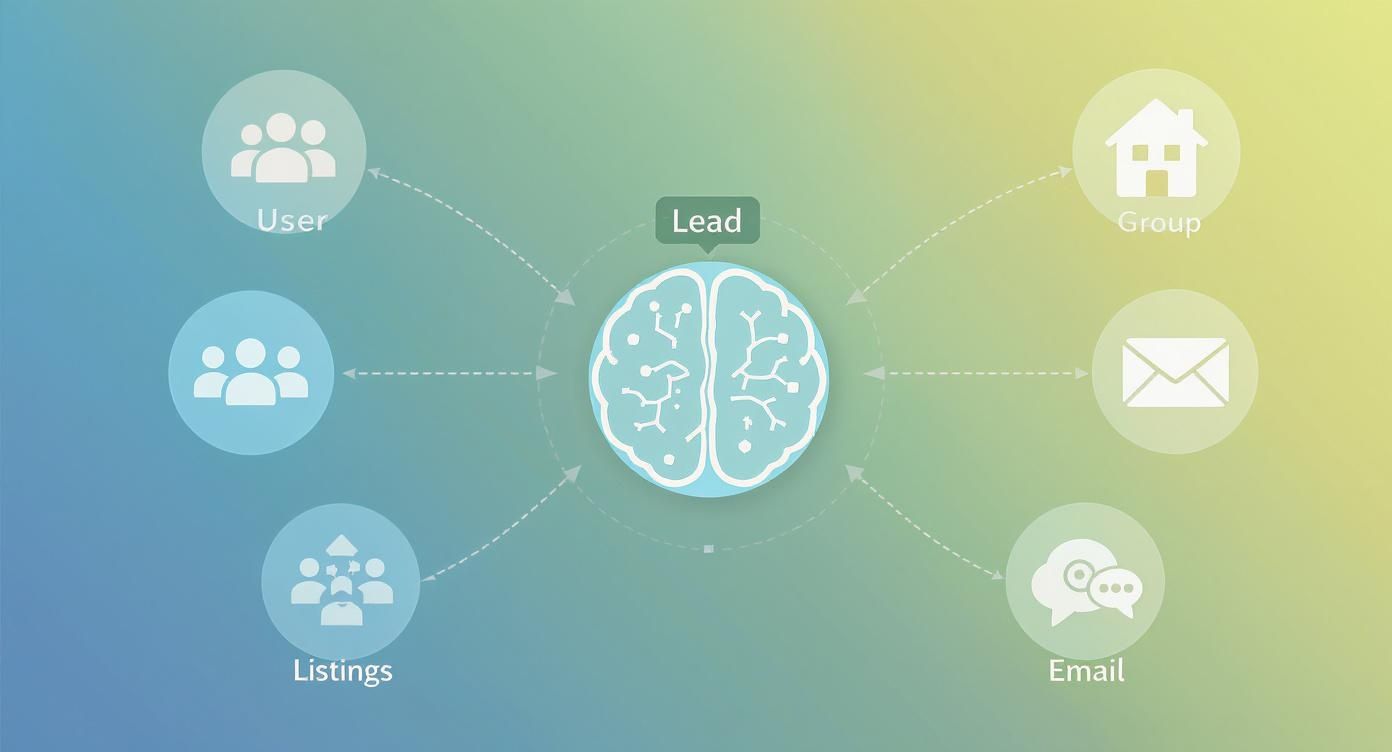
Let's break down the essential features that make it all happen.
1. Automated Drip Campaigns for Nurturing Leads
This is where the magic really starts. Automated drip campaigns are your 24/7 follow-up assistant. Imagine a potential buyer signs up on your website at 11 PM on a Friday. Instead of silence, they immediately get a warm, personalized welcome email.
But it doesn't stop there. That email is just the first step in a pre-built sequence of messages you designed. Over the next few weeks, the system will automatically "drip" helpful content to them—maybe a local market report, a guide for first-time homebuyers, or new listings that match their interests. You set it up once, and it works tirelessly for every new lead, keeping you top of mind without you lifting a finger.
2. AI-Powered Lead Scoring to Find the Hot Leads
Let's be honest, not every lead is ready to buy tomorrow. Some are just starting their search, while others are itching to make an offer. AI-powered lead scoring helps you tell the difference.
The system acts like a detective, watching how each lead interacts with your marketing. It tracks their digital body language and assigns points for meaningful actions.
- Viewed a single property? +5 points
- Saved a listing as a favorite? +15 points
- Visited your "Book a Showing" page? +25 points
When a lead’s score hits a certain threshold, the system flags them as "hot." You can even get an instant notification to your phone, telling you it’s the perfect time to pick up the phone and make a personal connection. This simple feature ensures you’re always focusing your energy on the people most likely to convert.
3. Seamless CRM Integration for a 360-Degree View
Your Customer Relationship Management (CRM) platform is your business's memory. It holds every detail about your clients. That's why seamless CRM integration is non-negotiable for any marketing automation tool.
When your systems are connected, every marketing interaction is automatically logged in the client's profile. Did they open your newsletter? Click on that new condo listing? It’s all recorded without any copy-pasting or manual data entry.
The goal is to create a single source of truth for every client. When your marketing platform and CRM speak the same language, you can personalize your communication based on a person’s entire history with your business, not just their last click.
This unified view is what allows for truly personal marketing. You could, for instance, instantly create a list of everyone who’s looked at three-bedroom homes in a specific school district in the last 30 days and send them a targeted email about a new listing that just hit the market.
4. Automated Content Creation for Listings and Social Media
The final piece of the puzzle is automating the content itself. Top platforms are now incorporating tools that can automatically generate marketing materials for your listings.
A great example is automated video creation. This feature can take the professional photos from a new listing and instantly turn them into an engaging video slideshow, complete with music, branding, and contact information. Many agents use a dedicated real estate video app that plugs right into their marketing stack to get this done.
Combined, these four features create a system that doesn’t just save you time—it actively works to grow your business by nurturing leads, identifying your best opportunities, and keeping your data perfectly in sync.
How to Choose the Right Automation Software
Picking the right marketing automation software can feel overwhelming. You're faced with a dizzying array of features, pricing plans, and slick sales pitches. So, how do you cut through the noise?
The secret is to ignore the flashy bells and whistles—at least at first. Instead, start by pinpointing your biggest headaches. Are you constantly losing leads because your follow-up is too slow? Do you spend entire weekends creating social media posts for new listings? Answering these questions first helps you find a platform that actually solves your problems and gives you a real return. You want a tool that fits your business like a glove, not one that makes you overhaul your entire process.
Getting this right is more critical than ever. The North American real estate software market is expected to explode from USD 3.5 billion to USD 9.1 billion by 2035, fueled by the industry's massive shift toward cloud and AI-powered tools. Everyone is looking for an edge in efficiency and client engagement, and making a smart choice now will keep you competitive. You can read more about these technological advancements in real estate and see where things are headed.
Define Your Core Needs First
Before you schedule a single demo, take a few minutes to jot down your top three to five marketing challenges. This simple list will be your North Star, guiding you to the features that will actually make a difference in your day-to-day.
With that list in hand, you can start evaluating platforms based on how well they address your specific issues. This keeps you from getting sold on a tool that’s amazing at something you don’t even do.
- Struggling with lead follow-up? Look for powerful drip campaign builders and AI that can score leads for you.
- Drowning in social media work? Prioritize tools that automate content creation and scheduling.
- Need to manage a team? Focus on platforms with smart lead routing and shared dashboards.
This approach ensures your investment is tied directly to a business outcome, whether that's a higher conversion rate or simply more time to spend with clients.
Evaluate Critical Integration Capabilities
Your marketing automation tool can't live on an island. It has to talk to the other software you use every day, especially your CRM and your MLS provider. If they don't connect smoothly, you'll just end up wasting hours on manual data entry, which defeats the whole point of automation.
Think of your tech stack like a team of specialists. Your CRM is the brain, your MLS is the inventory, and your automation platform is the communication director. They all have to speak the same language to get anything done.
When you're looking at a new tool, be direct. Ask if it has a native, one-click connection to your CRM. If not, you might have to rely on a third-party connector like Zapier to bridge the gap. Native integrations are almost always more reliable and powerful, letting data flow seamlessly without you having to constantly fix things.
Analyze Pricing Models and Scalability
Alright, let's talk money. Software pricing can be intentionally confusing, with different models that make it tough to compare apples to apples. You need to look past the monthly sticker price and understand the total cost of what you're buying.
The checklist below can help you systematically compare your options and dig into the details that matter.
Software Evaluation Checklist
Use this table to ask the right questions and keep your notes organized as you evaluate different platforms.
| Evaluation Criteria | Question to Ask | Your Notes |
|---|---|---|
| Core Need Alignment | Does this software directly solve one of my top 3-5 business challenges? | |
| CRM Integration | Is there a native, reliable integration with my current CRM? | |
| MLS Integration | Can it pull listing data directly from my MLS? Is it automated? | |
| Ease of Use | Is the interface intuitive? How steep is the learning curve for me and my team? | |
| Pricing Model | Is it priced per user, per contact, or a flat fee? Are there hidden costs? | |
| Scalability | Can this platform grow with my business? What's the cost to add users or contacts? | |
| Support & Training | What kind of customer support is included? Is training available? | |
| Specific Features | Does it have the key features I need (e.g., video automation, lead scoring)? |
Thinking about scalability is just as crucial as the initial price. The platform that works wonders for you as a solo agent might become a bottleneck when you have a team of ten. Look for a solution that offers a clear growth path, letting you add more users, contacts, and features as your business expands. That foresight will save you from a painful software migration in a few years.
Real-World Scenarios for Real Estate Professionals
It's one thing to read a list of features, but it’s another to see how real estate marketing automation software actually works in the real world. Let's step away from the theory and look at how these tools solve the everyday headaches that agents, teams, and brokerages face.
These aren't just made-up stories; they're common examples of how pros are getting their time back and growing their businesses. Each scenario pinpoints a specific problem, walks through the automated fix, and shows the real results.

The Solo Agent Reclaiming Her Evenings
Meet Sarah, a dedicated solo agent. Her phone is constantly buzzing with leads from Zillow, her website, and open houses. The problem? By the time she’s done with showings and contracts, it’s late, and those fresh leads have gone cold. She was losing business simply because she couldn't be in three places at once.
Sarah decided to set up an automated lead nurturing workflow. Here’s what it does:
- Instant Engagement: The second a new lead comes in, the system shoots off a personalized welcome text and email. This immediate response makes potential clients feel heard and valued.
- Smart Segmentation: The software looks at where the lead came from and what they asked about (e.g., a buyer asking about 123 Main St. vs. a seller wanting a home valuation). It then drops them into the right follow-up campaign.
- Long-Term Nurturing: For months, the system automatically sends relevant content—new listings for buyers, market reports for sellers—keeping Sarah top-of-mind without her lifting a finger.
The payoff was huge. Sarah’s lead response time went from hours to mere seconds, and her conversion rate for online leads jumped by 30% in the first three months. Best of all, she can finally end her workday on time, knowing her marketing is still running 24/7.
The Growing Team Managing High Volume Rentals
Now, let's look at a small but busy property management team. They were drowning in rental inquiries. Day in and day out, they answered the same questions: "Is it still available?" "What's the pet policy?" "When can I see it?" It was a recipe for burnout, and worse, they were accidentally ignoring great applicants.
By automating the initial inquiry and qualification process, the team transformed their workflow. They went from being reactive and overwhelmed to proactive and organized, ensuring every potential tenant received a fast, professional response.
Their automated fix was all about efficiency:
- AI-Powered Chatbot: They put a chatbot on their website that instantly answers common questions, any time of day or night.
- Automated Pre-Screening: When someone shows interest, the system automatically sends them a quick pre-screening questionnaire. Based on the answers, it can schedule a viewing or politely let them know if they don't meet the criteria.
- Showing Reminders: After a viewing is booked, the system sends automated text reminders to cut down on no-shows.
This simple setup allowed the team to handle twice the volume of inquiries without hiring more people. Their properties started leasing faster, and they got more five-star reviews praising how responsive they were.
The Brokerage Ensuring Brand Consistency
Finally, picture a brokerage with 50 agents. The marketing director's biggest nightmare is brand consistency. Some agents create gorgeous social media posts for their listings, while others... don't. The result was a messy and unprofessional brand image.
This is a huge issue industry-wide. It's a key reason why the global real estate software market, currently valued at USD 13.65 billion, is expected to more than double. While commercial real estate is a big driver, brokerages are pouring money into platforms that create a unified, professional look. You can read more about the real estate software market on coherentmarketinsights.com.
The brokerage solved this by using a marketing automation platform with centralized templates. Now, when an agent gets a new listing, they just upload the photos and details into the system. From there, automation handles the rest:
- It automatically creates professionally branded social media graphics and videos.
- It sends "Just Listed" email campaigns to the agent's contacts.
- It even launches digital ad campaigns targeting the right kinds of buyers.
This approach ensures every single listing gets top-tier marketing, lifting the entire brokerage's reputation. It also gives agents who aren't marketing whizzes the tools they need to succeed, which boosts both morale and sales.
Setting Up Automation and Measuring Your Success
Picking the right real estate marketing automation software is a great start, but the real magic happens when you set it up thoughtfully and have a clear way to measure your results. This is how you transform a monthly subscription into a genuine growth engine for your business. The initial setup isn't just flipping a switch; it's about building a smart foundation for everything that comes next.
Think of it like setting up a new smart home system. You wouldn't just plug everything in and hope for the best, right? You’d carefully connect each device, program your preferences, and create "scenes" that make your life easier—like having the lights dim and your favorite playlist start automatically when you get home. Getting your automation software running follows the exact same logic. You start by connecting your contacts, building your first couple of workflows, and getting your team comfortable with the new tools.

Your First Steps in Implementation
Getting started can feel like a massive project, but if you break it down into a few manageable pieces, it's actually pretty straightforward. The goal here is to get a couple of high-impact automations running quickly so you can start seeing the payoff right away.
Focus on these core tasks first:
- Migrate Your Contacts: Your client list is your goldmine. The very first thing to do is import all your contacts from your CRM, spreadsheets, or wherever else they live into the new platform. A clean, organized database is the fuel for every automated campaign you’ll ever run.
- Set Up Your First Workflow: Don't try to automate your entire business on day one. Pick one high-impact task to start, like following up with new leads. Create a simple workflow that sends an instant text and a welcome email to every new person who inquires. This one automation alone can drastically improve your response time and win you more clients.
- Train Your Team: A tool is only as good as the people using it. Block out some time for a dedicated training session to walk your team through the new system. To keep it from being overwhelming, focus only on the one or two workflows they'll be using every day.
Measuring What Truly Matters
Once your system is up and running, you've got to prove it's actually working. This means looking past "vanity metrics" like social media likes and zeroing in on Key Performance Indicators (KPIs) that directly affect your bottom line. These are the numbers that prove you're not just busy, but productive.
Forget tracking metrics that don't translate to closed deals. The right KPIs tell a clear story about your efficiency, lead quality, and ultimately, your profitability. They turn automation from a business expense into a measurable investment.
Start by keeping an eye on these essential real estate KPIs:
- Lead Response Time: How fast are you getting in touch with a new lead? Automation should shrink this down to under five minutes. Businesses that hit this mark are a staggering 100 times more likely to actually connect with a lead.
- Appointment Booking Rate: Of all the qualified leads you get, what percentage actually book a call or a showing? This KPI shows you whether your nurturing campaigns are doing their job and moving people forward.
- Cost Per Qualified Lead: How much are you spending to get a lead who is genuinely ready to talk? Good automation drives this cost down by improving your follow-up and weeding out the tire-kickers.
- Lead-to-Client Conversion Rate: This is the big one. What percentage of your initial leads eventually close a deal with you? This number gives you a clear picture of the overall health of your sales and marketing process. For more ideas on improving this, check out our complete guide to digital marketing for real estate agents.
Calculating Your Return on Investment
Finally, it’s time to calculate your Return on Investment (ROI) to see the cold, hard financial impact of your software. A simple way to do this is to compare the gains you’ve made from automation to what it costs you.
First, figure out the new value you’ve generated. For instance, if your new system helped you close just two extra deals this year, what's the total commission from those sales? Then, tack on the value of the time you saved. If automation gives you back 10 hours a week, what is that time worth to your business?
Now, subtract the total annual cost of the software. The number you're left with is your net profit from using the platform. Seeing that positive number in black and white is the clearest possible proof that your real estate marketing automation software isn't just another tool—it's a critical part of your success.
The Future of Real Estate Is Automated
As we've explored throughout this guide, real estate marketing automation software isn't just another shiny object to add to your toolbox. It’s a fundamental change in how the game is played. This is the engine that keeps your lead nurturing running 24/7, your social media consistent, and your client database perfectly organized—all while you focus on what really matters: building relationships.
The bottom line is simple. Automation isn't a luxury reserved for the top 1% anymore; it's the new standard for any agent or team who wants to keep up, let alone get ahead. It’s how you build a smarter business that can actually grow without burning you out. The old way of doing things—patching together marketing tasks manually—is on its way out, replaced by systems that create better experiences for clients and deliver results you can actually measure.
Emerging Trends on the Horizon
As impressive as today's tools are, we're just scratching the surface. The next generation of automation is shaping up to be even smarter and more woven into the very fabric of every real estate deal.
Here are a few key trends to keep an eye on:
- Hyper-Personalization at Scale: We're moving way beyond basic email segments. Future AI will learn to predict what a client needs based on their online behavior. Imagine your system automatically sending a video tour of a brand-new listing the second it hits the market because it perfectly matches a prospect's saved search.
- Deeper Tech Stack Integration: Get ready for seamless, two-way conversations between all your software. Your marketing platform won't just sync with your CRM; it’ll connect to your transaction management software, your calendar, and even your smart lockbox to create one truly cohesive workflow.
The next wave of automation isn't just about sending the right email. It's about anticipating a client's next move and delivering value before they even think to ask, creating a smooth journey from their first click to the closing table.
Your Next Step Toward Automation
The thought of re-engineering your entire marketing process can feel overwhelming. But you don't have to boil the ocean. The path to a more efficient business starts with one small, smart step.
Take a second to think about your daily to-do list. Where does all your time go? Is it spent manually chasing down cold leads? Or maybe it's the hours you sink into creating social media posts for every new listing.
Find that one bottleneck—the single biggest time-drain in your day. That’s your starting point. Solving just that one problem with a simple automated workflow won't just give you back hours of your life; it will build the confidence and momentum you need to create a more profitable, future-proof business.
Frequently Asked Questions
Jumping into automation can feel like a big leap. It’s a major shift in how you run your business, so it's totally normal to have a few questions before you dive in. Here are some straight answers to the most common things agents ask about real estate marketing automation software.
Will Automation Make My Communication Feel Robotic?
This is probably the biggest worry I hear, and it’s a good question. The short answer is no—not if you do it right. Good automation isn’t about replacing your personality; it’s about scaling it. Think of it as your personal assistant handling the repetitive stuff so you can focus on the real conversations.
For instance, an automated welcome text to a new lead is just a quick way to say, "Hey, I got your inquiry and I'll be in touch soon!" The system handles the instant reply, which means you can follow up with a genuine, personal call a little later without the lead feeling ignored. The real goal here is to make sure every single lead gets an immediate response, which frees you up to provide that white-glove service to the people who are ready to talk.
How Much Does This Software Typically Cost?
The price range is pretty wide. You can find basic tools starting around $50 per month, while more powerful platforms for big teams can run several hundred dollars. Usually, the cost depends on how many contacts you have or the number of agents on your team.
But when you're looking at the price, don't just focus on the monthly fee. Think about the hours you'll get back each week. What's that time worth to you? More importantly, what if the software helps you close just one extra deal this year? For most agents, the commission from a single extra transaction could pay for the software for years.
Don’t just compare price tags; compare the potential impact on your bottom line. A slightly more expensive tool with powerful lead-scoring features might generate far more revenue than a cheaper, simpler option by helping you focus on the hottest leads.
How Long Does It Take to See Results?
You can see some results almost right away. Seriously. Setting up a simple workflow, like an instant text reply to new Zillow leads, can take less than an hour. The impact of that one change—slashing your response time from hours to seconds—is something you can feel in the first week.
Bigger, more meaningful results, like a noticeable jump in your conversion rate, usually take about one to three months. That gives your automated follow-up campaigns enough time to actually nurture leads and gives you enough data to see what’s working.
Can I Integrate This with My Current CRM?
Absolutely. In fact, you shouldn't buy a tool that doesn't. Great automation software is built to play nicely with the most popular real estate CRMs out there. This connection is key because it means all your marketing interactions—every email opened, every link clicked—get logged right into your contact's record automatically.
This creates one clean, unified profile for every person in your database. You can see their entire history at a glance and make much smarter decisions without ever having to manually copy and paste information between two different systems again.
Ready to stop wasting time on manual marketing and start getting more from your listings? With AgentPulse, you can create stunning, cinematic videos from your listing photos in minutes.